








AI & Emerging Tech
Southeast Asia moves from AI pilots to enterprise scale, but specialised talent gap slows progress







Many organisations face a shortage of specialised skills needed to scale AI, particularly in software development and MLOps, which are essential to deploy, manage and maintain AI systems in real-world production environments.
Artificial intelligence (AI) is rapidly moving from experimentation to everyday business use across Southeast Asia, as companies deploy the technology across operations, customer service and decision-making processes.
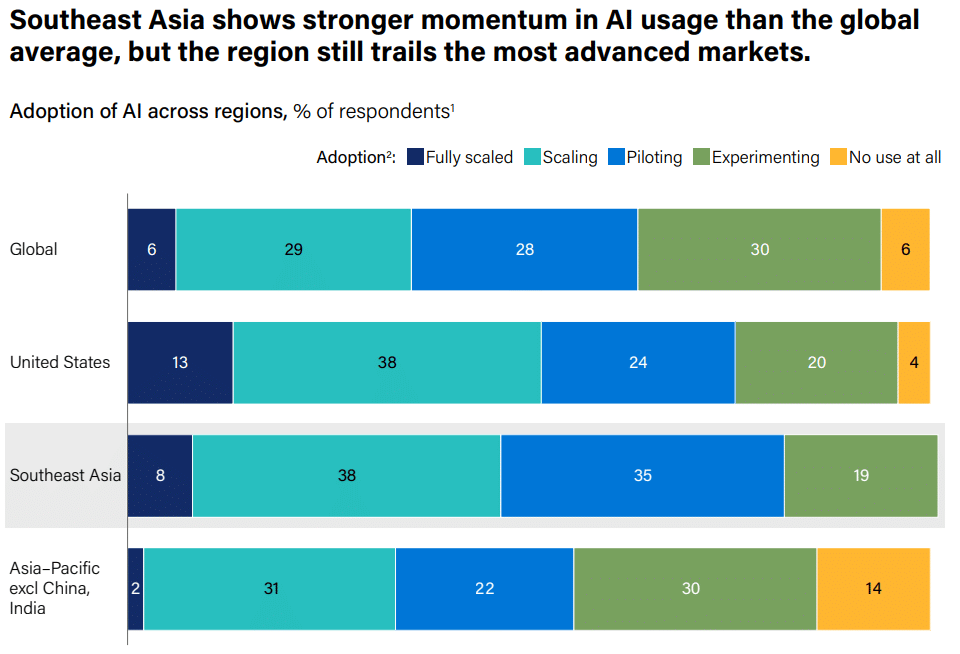
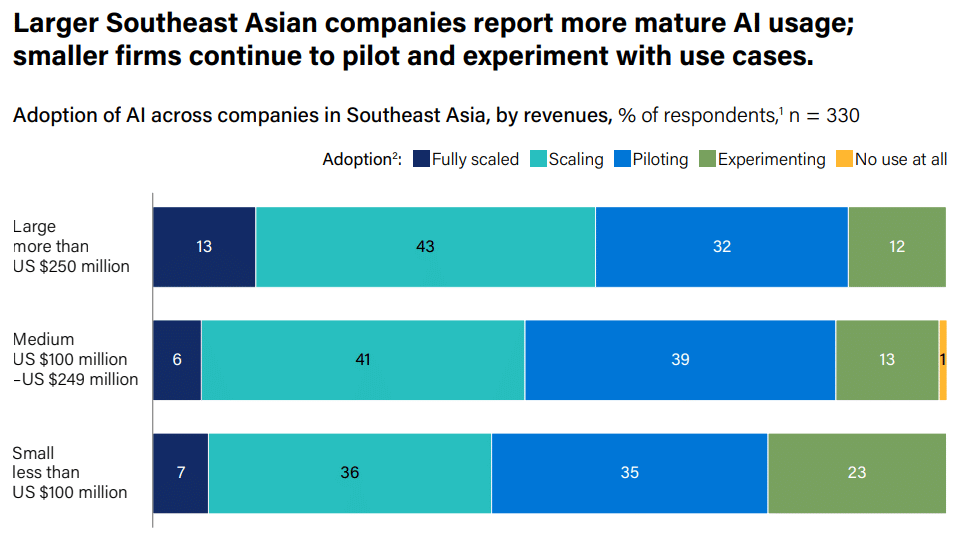
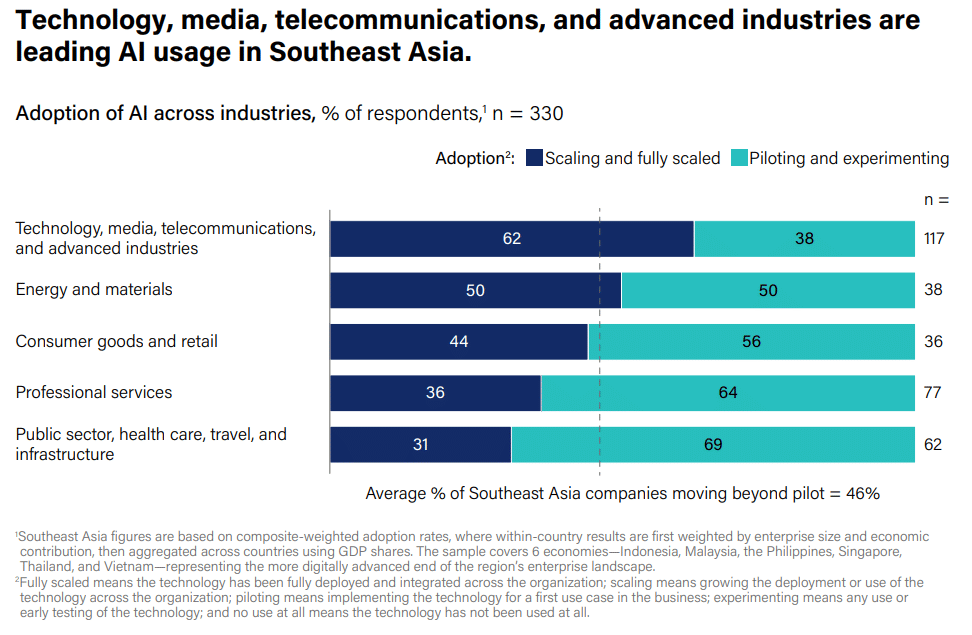
According to the report titled, 'AI in Southeast Asia: An Era of Opportunity' by McKinsey, the Singapore Economic Development Board and Tech in Asia, AI adoption across the region is accelerating, with businesses increasingly integrating the technology into core functions rather than isolated pilot projects.
The report also found that 81 per cent of companies across the region have moved beyond AI experimentation, and in Singapore, 56 per cent of firms reported progress toward scaled adoption.
Singapore has also emerged as a regional AI hub, hosting more than 60 AI centres of excellence operated by global technology companies such as Alibaba Cloud, IBM, Nvidia and Oracle, which are contributing to new tools, jobs and training opportunities.
Leadership commitment emerging as key factor
Beyond technology investment, leadership commitment is emerging as a critical factor in successful AI adoption. The report notes that companies are more likely to scale AI when CEOs and boards clearly understand its long-term value and commit fully to its implementation.
This is particularly relevant in Southeast Asia, where many businesses are family-owned or founder-led and decision-making often follows a top-down structure. Leaders in such organisations tend to take a long-term view, positioning AI as a strategic driver of financial and operational growth rather than a short-term experiment.
Globally, AI adoption is also expanding across business functions. More than two-thirds of organisations now use AI in at least one function, and about half report using it in three or more functions. This reflects a broader shift from isolated pilots to integrated, enterprise-wide applications.
Agentic AI begins to take hold
A new phase of adoption is also emerging with the rise of agentic AI, systems capable of understanding context, making decisions and taking actions with limited human intervention.
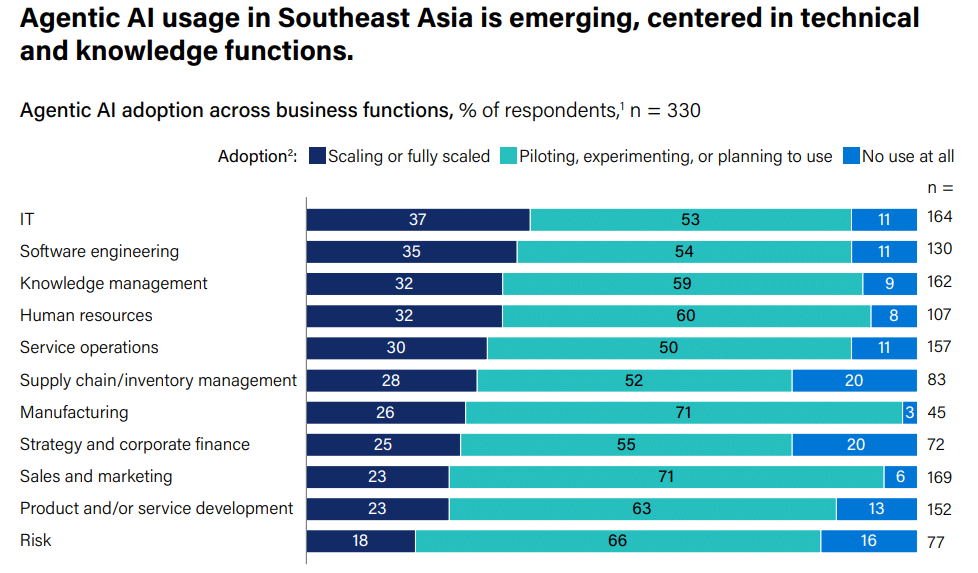
Across Southeast Asia, adoption of agentic AI is currently concentrated in technical and knowledge-driven functions such as IT, software engineering and knowledge management, where more than one-third of companies are already scaling or have fully scaled such systems.
In contrast, customer-facing functions such as sales, marketing, product development and risk management remain in earlier stages of adoption.
Companies are moving more cautiously in these areas due to reputational risks, customer experience concerns and the need for human oversight. Roughly one in five companies in these externally facing functions are scaling agentic AI, while most are still piloting or planning deployment.
Another challenge is the shortage of specialised skills required to deploy AI at scale. While many organisations have invested in data scientists and data engineers, they often lack software development and MLOps capabilities needed to deploy and maintain AI systems in production environments.
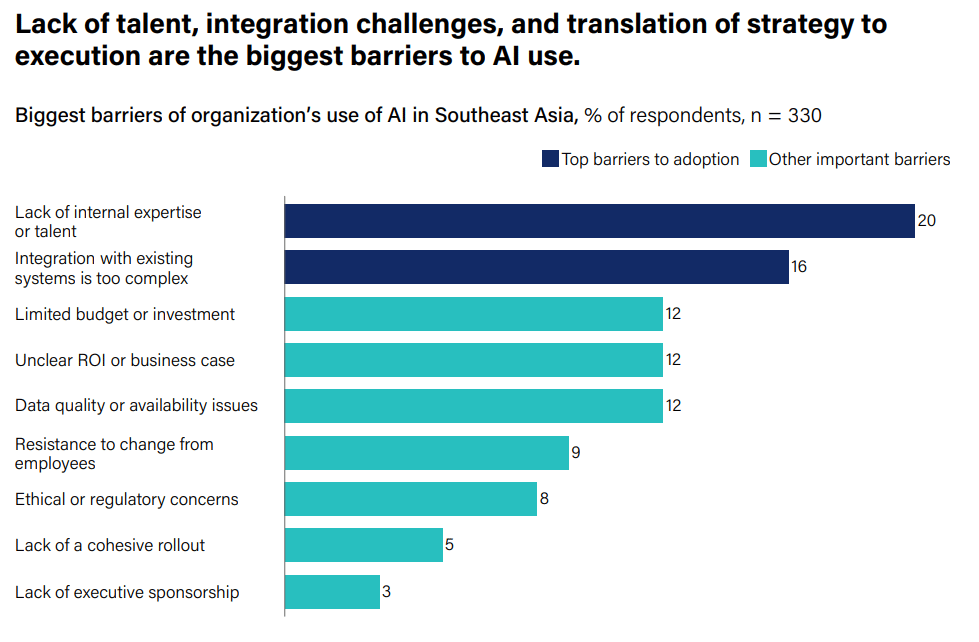
Despite these challenges, interest remains high. Nearly nine in ten companies across Southeast Asia say they plan to experiment with AI agents in the coming year, suggesting that adoption could expand rapidly beyond technical functions into broader enterprise operations.
AI seen as growth driver, not just automation tool
Companies across the region are increasingly using AI to automate repetitive tasks, improve decision-making and support employees rather than replace them.
At Grab, AI tools have already been deployed across its ecosystem of merchants and drivers. According to the company, merchants using its AI assistant have seen business growth of about 10 per cent, highlighting the commercial impact of AI adoption.
Industry leaders increasingly emphasise that the future workplace will be defined by collaboration between humans and AI rather than replacement.
As AI adoption scales across Southeast Asia, companies are focusing not only on technology investment but also on leadership alignment, workforce skills and responsible implementation, factors that will ultimately determine how successfully AI transforms businesses across the region.
Topics
Author
Loading...