








Business
The world's biggest companies list has a new winner and it's not Apple, Amazon or Microsoft






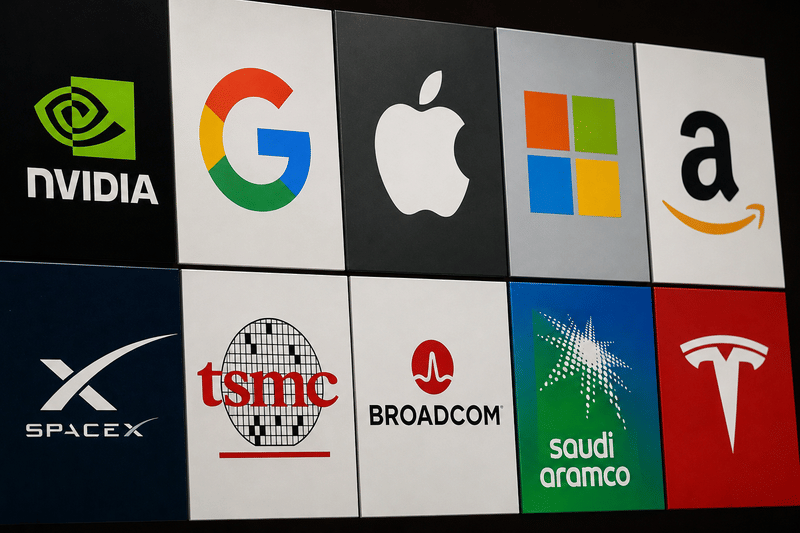
Nvidia has climbed to the top of the global corporate rankings, overtaking long-time technology leaders as artificial intelligence continues to reshape market value across industries.
The global race for corporate dominance has a new leader. Nvidia, the semiconductor company at the heart of the artificial intelligence boom, has emerged as the world's most valuable company in 2026, surpassing household names including Apple, Microsoft and Amazon.
According to rankings published by CompaniesMarketCap, Nvidia now holds a market capitalisation of $5.145 trillion, placing it ahead of every publicly listed company globally and underscoring the growing influence of AI infrastructure on financial markets.
The latest rankings highlight a broader shift in corporate power, with chipmakers, AI-focused businesses and digital platforms increasingly occupying the top positions once dominated by traditional technology and energy giants.
AI reshapes the corporate leaderboard
For years, Apple, Microsoft and Amazon defined the upper tier of global market value. The 2026 rankings tell a different story.
Nvidia's rise reflects investor confidence in the company's role as a critical supplier of the chips powering artificial intelligence systems, cloud computing infrastructure and next-generation data centres.
The rankings place Alphabet, Google's parent company, in second place, while Apple and Microsoft occupy third and fourth positions respectively.
The top five companies by market capitalisation are:
- Nvidia: $5.145 trillion
- Alphabet (Google): $4.479 trillion
- Apple: $4.353 trillion
- Microsoft: $2.969 trillion
- Amazon: $2.646 trillion
The gap between Nvidia and some of its long-standing technology rivals illustrates how rapidly investor attention has shifted towards businesses enabling AI development.
SpaceX joins the global elite
One of the most notable developments in the rankings is the appearance of SpaceX in sixth position.
Founded by Elon Musk, the private aerospace company has reached a reported market value of $2.519 trillion, placing it ahead of several established multinational corporations.
The result reflects growing investor interest in sectors extending beyond traditional software and consumer technology, including space technology, satellite communications and advanced manufacturing.
The remainder of the top 10 includes:
- SpaceX: $2.519 trillion
- TSMC: $2.289 trillion
- Broadcom: $1.874 trillion
- Saudi Aramco: $1.721 trillion
- Tesla: $1.544 trillion
Technology dominates the rankings
A closer look at the list reveals the extent to which technology companies now shape global markets.
Seven of the ten highest-valued companies operate primarily in technology, semiconductors, digital platforms or related sectors.
The presence of Nvidia, Alphabet, Apple, Microsoft, Amazon, TSMC, Broadcom and Tesla highlights the growing importance of artificial intelligence, cloud computing, digital commerce, semiconductors and advanced hardware in driving corporate valuations.
Even among non-traditional technology companies, innovation remains a central theme. SpaceX's position reflects advances in commercial space operations, while Saudi Aramco remains the only energy company in the top ten.
What the rankings reveal about the future economy
The latest list is more than a snapshot of market value. It offers insight into where investors believe future growth will emerge.
Companies linked to AI infrastructure, semiconductor manufacturing, digital ecosystems and advanced technologies now command a growing share of global capital. Nvidia's ascent to the top spot is perhaps the clearest indication yet that artificial intelligence has moved from an emerging technology trend to a central force shaping the global economy.
As businesses continue investing in AI, cloud infrastructure and next-generation technologies, the composition of the world's most valuable companies may continue to evolve. For now, however, the centre of corporate power has shifted decisively towards the companies building the foundations of the AI era.
Topics
Author
Loading...