








Compensation Benefits
Singapore salary increases to remain steady at 4% in 2027 as employers prioritise skills and role redesign: WTW






While 58% of Singapore employers plan no major changes to compensation programmes, 28% have reviewed pay across all employees, 26% assessed specific groups, and 18% raised starting salaries.
Salary increase budgets in Singapore are expected to remain stable in 2027 as employers shift from broad-based pay hikes to more targeted reward strategies focused on critical skills, role redesign and workforce resilience, according to WTW's latest Salary Budget Planning report.
The report found that organisations in Singapore recorded an actual salary increase of 3.9% in 2026, marginally lower than the 4.0% increase in 2025. Salary budgets are projected to return to 4.0% in 2027, reflecting a cautious but steady compensation outlook.
Across Asia Pacific, salary budgets are also stabilising, with mature markets including Singapore, Hong Kong, Taiwan and Australia reporting measured increases as employers seek to balance cost discipline with the need to attract and retain key talent.
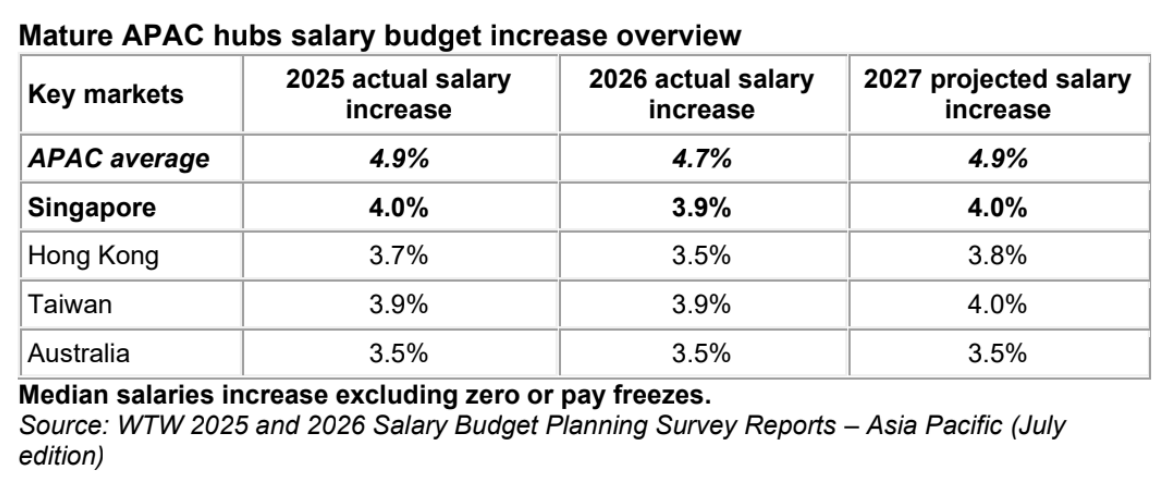
The APAC average salary increase stood at 4.7% in 2026, with projections rising to 4.9% in 2027. Hong Kong is expected to see salary increases rise from 3.5% in 2026 to 3.8% in 2027, while Taiwan is projected to move from 3.9% to 4.0%. Australia is expected to maintain steady salary growth at 3.5%.
Three-quarters of employers in Singapore reported salary increase adjustments ranging between 2.5% and 5.0%, highlighting a selective pay environment where increases are increasingly directed towards priority roles, high-demand skills and key workforce segments.
The report also showed that 54% of employers said their actual salary budgets in 2026 matched their original plans, while 26% reported lower-than-expected budgets and 7% exceeded their planned salary allocations. The findings suggest organisations are refining how salary budgets are distributed rather than expanding overall compensation spending.
Cost management remains the biggest factor shaping salary decisions, cited by 35.1% of employers. Inflationary pressures (31.1%), weaker financial performance (28.4%) and labour market and retention concerns (20.3%) also continue to influence compensation planning.
Beyond pay increases, organisations are increasingly investing in workforce design and employee experience. While 58% of employers do not intend to make major changes to their compensation programmes, 28% have conducted a full compensation review across all employees, 26% reviewed pay for specific employee groups, and 18% reported hiring employees higher within salary ranges or increasing starting salaries.
With around three-quarters of organisations planning to maintain current workforce levels over the next 12 months, employers are placing greater emphasis on training opportunities, employee experience, and health and wellness benefits to strengthen retention.
"This points to a more deliberate reward strategy, where employers are maintaining overall workforce stability while selectively investing in roles and capabilities that support digital transformation, regulatory resilience, customer engagement and operational execution," said DN Prasad, Head of Work & Rewards, Singapore at WTW.
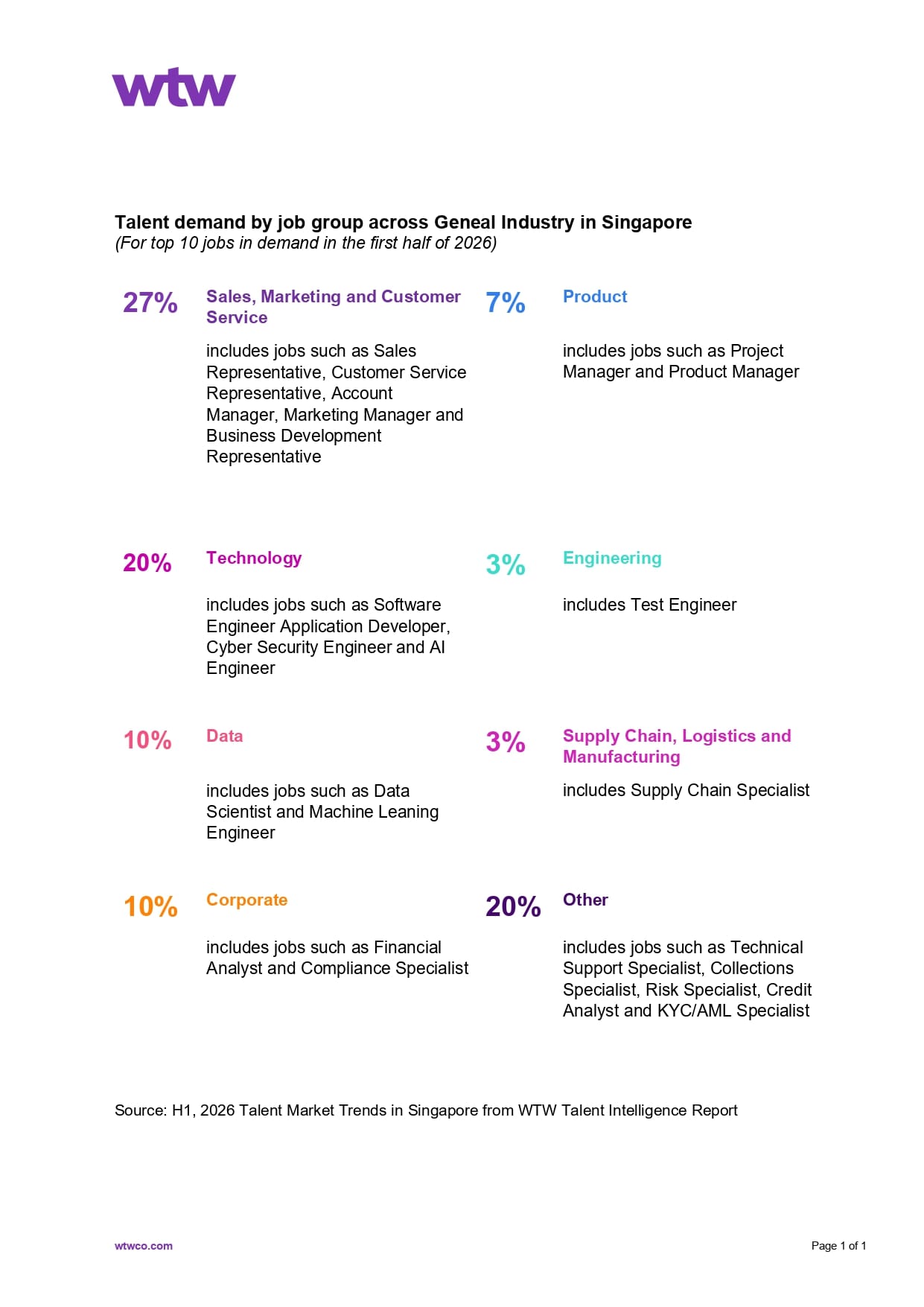
The report also highlighted continued demand for technology, commercial and governance talent across Singapore during the first half of 2026.
Customer-facing positions, including Sales Representatives and Account Managers, remain among the most sought-after roles despite growing AI adoption in customer service, reflecting continued demand for revenue generation and client relationship management.
Technology-related positions, including Software Engineers, AI Engineers, Data Scientists and Machine Learning Engineers, account for 30% of the top 10 in-demand jobs, underscoring the growing importance of digital transformation and AI across industries.
Cyber Security Engineers, Risk Specialists and Compliance Specialists also feature prominently as organisations respond to increasing regulatory requirements and evolving cyber risks.
"The Singapore talent market reflects the next phase of workforce transformation in the economy. As pay increases stabilise, companies are redesigning roles and strengthening job structures to better match skills with business priorities.
"Technology-enabled capabilities such as software development, data analysis, AI, automation and cyber security remain important, but they must be connected with commercial, customer and governance skills to create sustainable value. This makes it critical for employers to understand how roles are changing, where skills are needed and how reward decisions can support a future-ready workforce," added Prasad.
Topics
Author
Loading...