








Economy Policy
Malaysia enforces Gig Workers Act 2025, expanding legal protections for over 1.6 million workers







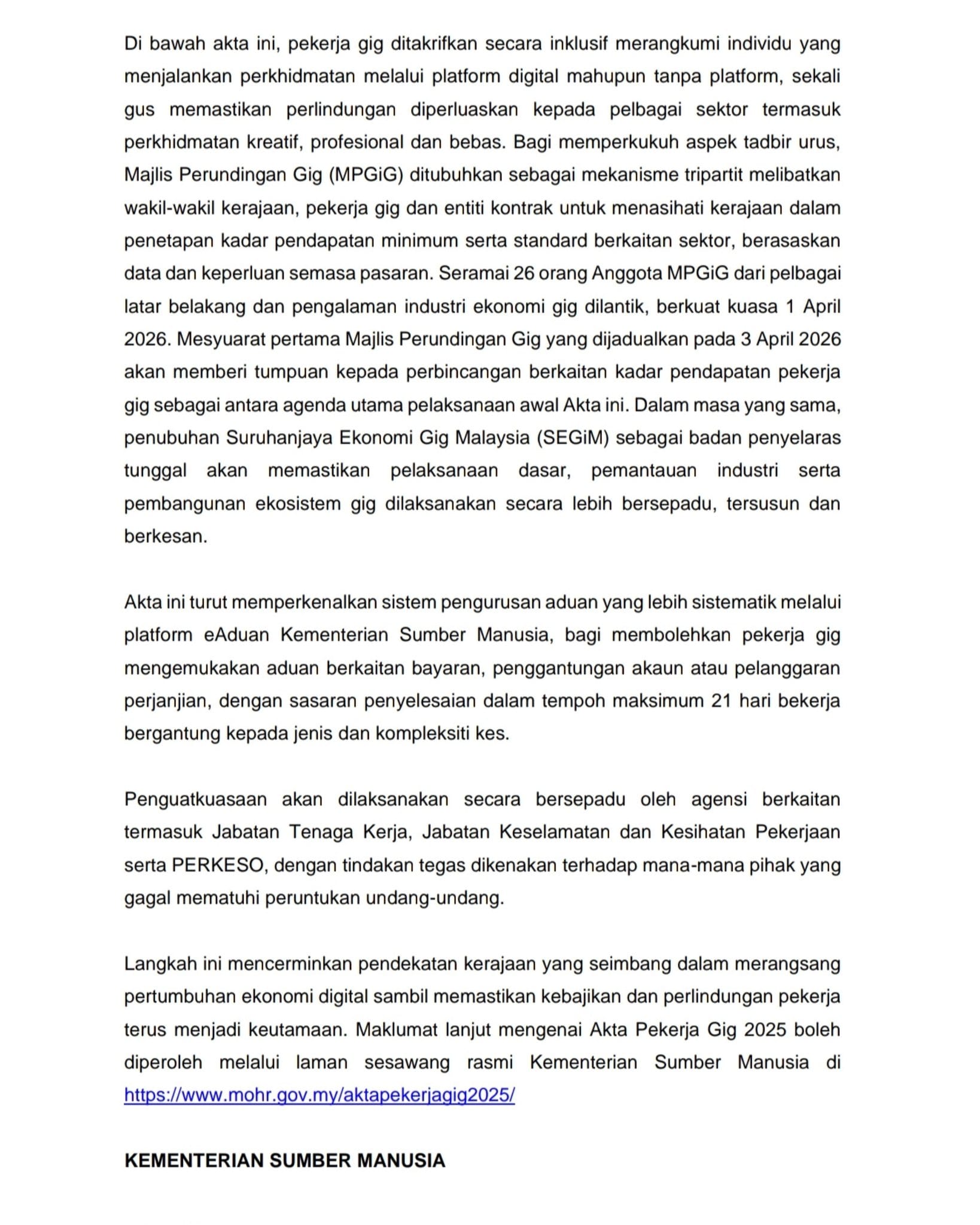
The Act covers both platform workers, such as e-hailing drivers and delivery riders, as well as non-platform gig workers in sectors including film, music, translation, creative work, and journalism.
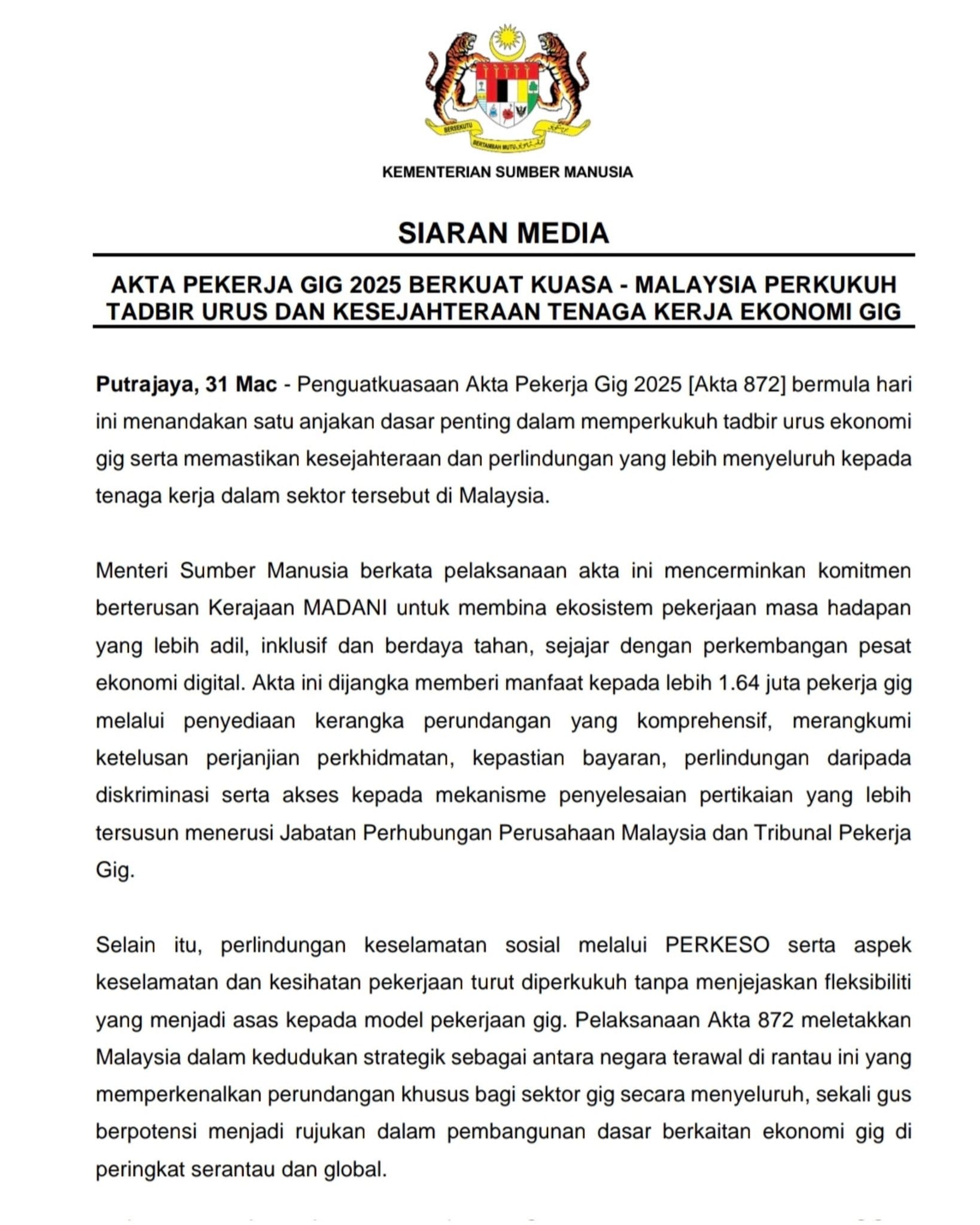
Malaysia’s Gig Workers Act 2025 (Act 872) officially came into force on March 31, marking a major milestone in regulating the country’s rapidly growing gig economy while strengthening welfare and protections for more than 1.6 million workers.
The new legislation introduces a comprehensive legal framework covering transparent service agreements, payment certainty, protection against discrimination, and access to dispute resolution mechanisms through the Industrial Relations Department and the Gig Workers Tribunal. It also expands social security coverage through PERKESO and strengthens occupational safety protections, while maintaining the flexibility that defines gig work.
Malaysia’s Ministry of Human Resources said the law reflects the government’s broader strategy to build a fair, inclusive and resilient future-of-work ecosystem as the digital economy continues to expand.
Human Resources Minister Datuk Seri R. Ramanan described the Act as a historic step for the country’s labour landscape. “This Act, which comes at a time when the employment landscape is changing, is a sign of our commitment to defend the fate and future of those who have been the backbone of the country’s digital economy,” he said during a media conference in Putrajaya.
He added that the legislation demonstrates the government’s commitment to ensuring that digital economy growth progresses alongside worker protection, positioning Malaysia as a potential model for fair and sustainable gig economy development.
Under Act 872, gig workers now have clearer legal protections, including transparency in service agreements, agreed income rates, prohibition of discrimination, social security coverage through PERKESO, and occupational safety and health protection.
The Act broadly defines gig workers as Malaysian citizens and permanent residents who enter into service agreements with contracting entities and are paid per task or service.
The law covers both platform workers, such as e-hailing drivers and delivery riders, as well as non-platform gig workers in sectors including film, music, translation, creative work, and journalism.
The legislation also introduces a more structured dispute resolution process. Disputes will first go through conciliation under the Industrial Relations Department, and unresolved cases will be referred to the Gig Workers Tribunal.
“If the dispute cannot be resolved at the conciliation stage, it will be referred to the Gig Workers Tribunal, which will conduct proceedings to ensure that the dispute is resolved professionally, free from external influence and based on the merits of the facts and the law,” Ramanan said.
The Act also introduces new rules on account suspensions by platform providers. Companies must provide written notice and investigations must be completed within 14 days. If workers are found not guilty, their accounts must be reactivated and they are entitled to compensation equal to 50% of their expected earnings during the suspension period.
To support enforcement and worker protection, the government has launched a new complaint management platform called eAduan, allowing gig workers to file complaints related to payments, account suspensions, or contract breaches. Authorities aim to resolve complaints within 21 working days, depending on case complexity.
The legislation also establishes the Malaysian Gig Economy Commission (SEGiM) to coordinate policy implementation, monitor industry developments and drive ecosystem growth, as well as a Gig Advisory Council (MPGiG) comprising representatives from the government, gig workers and contracting companies. The council’s first meeting is scheduled for April 3 and will focus on gig worker income rates and sector standards.
Officials said enforcement of the Act will involve multiple agencies, including the Labour Department, the Department of Occupational Safety and Health and PERKESO, with strict action to be taken against non-compliance.
The government said the move reflects a balanced approach to supporting digital economy growth while ensuring worker welfare remains a priority, placing Malaysia among the first countries in the region to introduce comprehensive legislation specifically for the gig economy sector.
Author
Loading...