








Economy Policy
Malaysia urges flexible work adoption to tackle energy crisis and economic uncertainty







The ministry said employers should adopt flexible work arrangements gradually, based on operational requirements, and make use of government guidelines and support programs available.
The Ministry of Human Resources Malaysia has called on private sector employers to adopt Flexible Work Arrangements (FWA) as part of a national strategy to address rising energy costs, global economic uncertainty, and employee well-being.
The call follows a recommendation by Prime Minister Anwar Ibrahim encouraging companies to introduce more flexible work policies, including working from home, to help the country manage the impact of the global energy crisis and economic volatility.
In a media statement, the ministry said Flexible Work Arrangements, known locally as Aturan Kerja Fleksibel (AKF), can help organizations operate more efficiently while maintaining productivity.
The ministry noted that increasing energy costs, partly driven by geopolitical conflicts in West Asia and reliance on daily commuting, have made flexible work policies more relevant than ever.
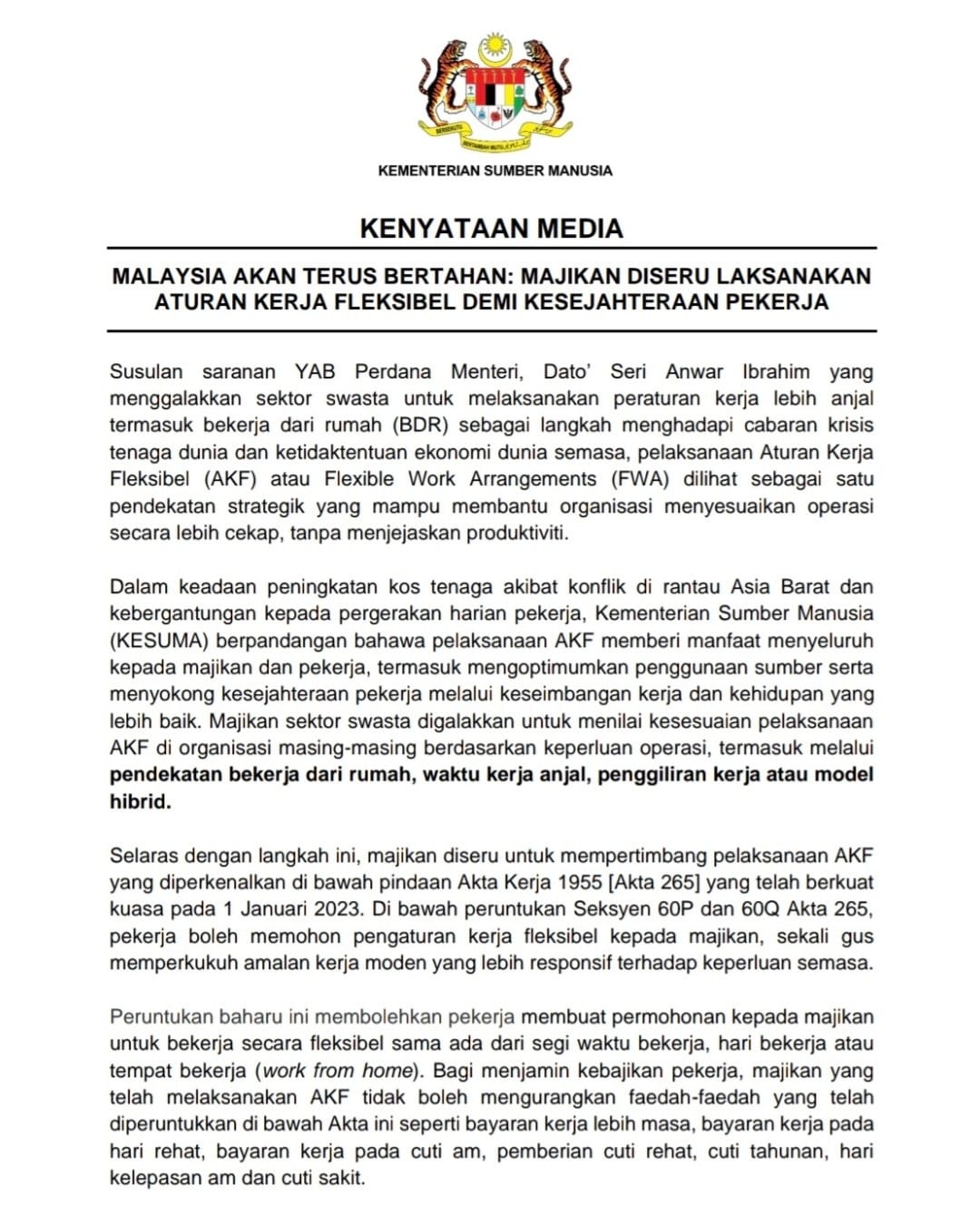
According to the ministry, implementing flexible work arrangements can benefit both employers and employees by optimizing resource use, reducing operational costs, and improving work-life balance and employee well-being.
Employers are encouraged to assess the suitability of flexible work arrangements based on operational needs. These arrangements may include working from home, flexible working hours, shift rotations, or hybrid work models.
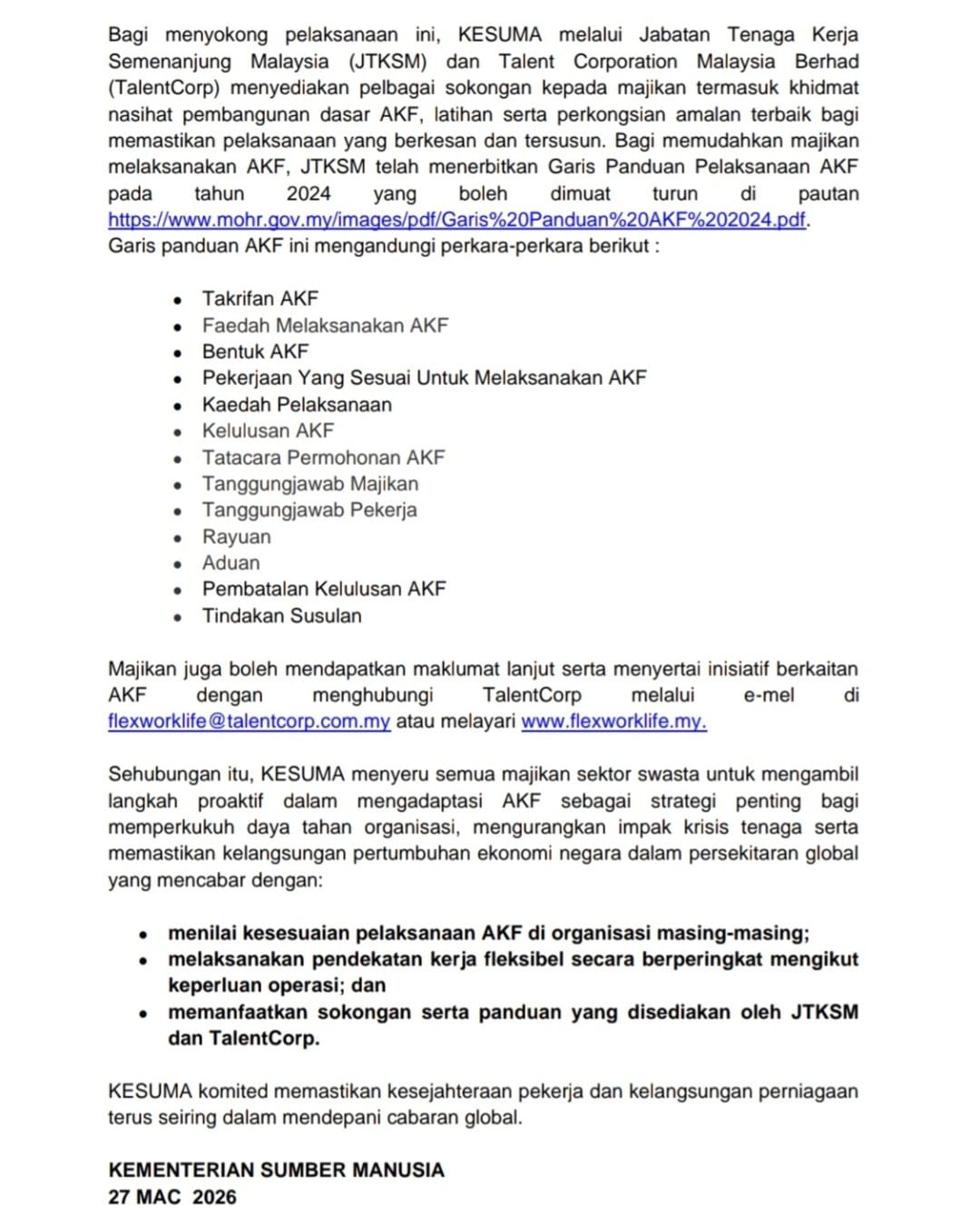
The ministry also highlighted that flexible work arrangements are supported under amendments to Malaysia’s Employment Act 1955, which came into force on January 1, 2023.
Under the law, employees can formally apply for flexible working arrangements covering working hours, working days, or workplace location.
However, the ministry stressed that employers implementing flexible work arrangements are not allowed to reduce statutory employee benefits such as overtime pay, rest day pay, public holiday pay, annual leave, sick leave, and other entitlements.
To support employers, the government, through the Department of Labour of Peninsular Malaysia and Talent Corporation Malaysia — is providing advisory services, training, and best practice sharing to help organizations implement flexible work policies effectively.
The ministry said employers should adopt flexible work arrangements gradually, based on operational requirements, and make use of government guidelines and support programs available.
The Ministry of Human Resources emphasized that flexible work arrangements will play an important role in strengthening business resilience, reducing the impact of the energy crisis, and ensuring continued economic growth while safeguarding employee welfare.
Topics
Author
Loading...