








Economy Policy
Singapore workplace fatality rate falls to record low 0.96 per 100,000 workers in 2025: MOM







Despite the record-low injury and fatality rates, authorities stressed that continued vigilance is necessary as workplace risks evolve with economic activity and new forms of work.
Singapore recorded its lowest-ever workplace fatality and major injury rates in 2025, reinforcing its position among the safest workplaces globally, according to new workplace safety data released on 25 March 2026.
The workplace fatal injury rate fell to a record low of 0.96 per 100,000 workers in 2025. Meanwhile, the workplace major injury rate excluding platform workers declined to an all-time low of 15.7 per 100,000 workers. With platform workers included, the rate stood at 17.7 per 100,000 workers. This was also the first year non-fatal injury data for platform workers was included, following the implementation of the Platform Workers Act on 1 January 2025.
These results place Singapore alongside countries such as Netherlands, United Kingdom, Germany and Sweden, which have consistently maintained workplace fatality rates below 1.0 per 100,000 workers.
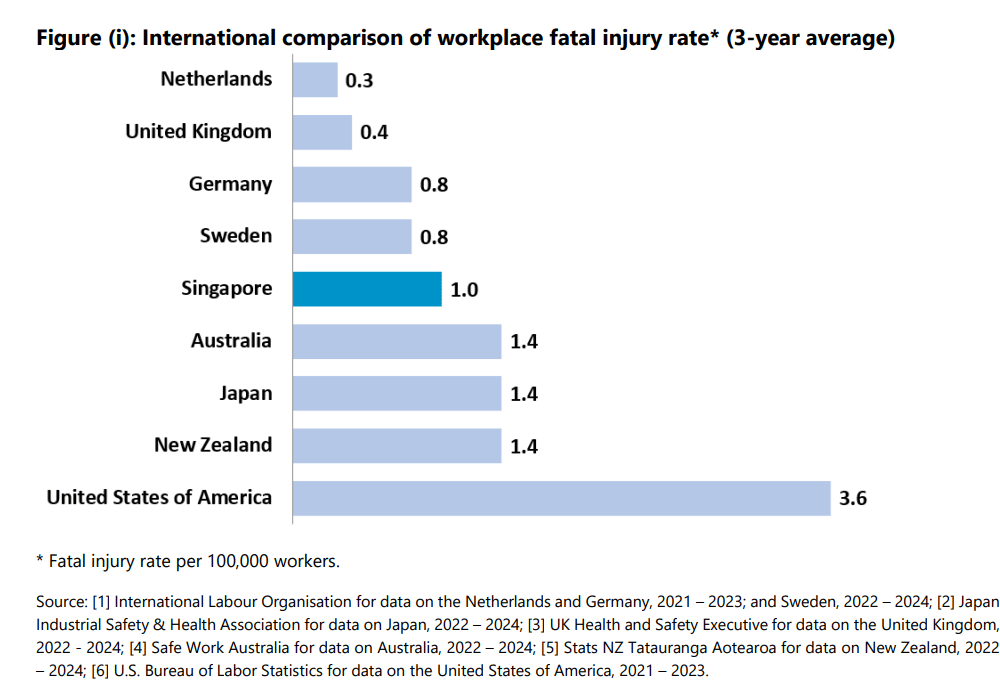
Authorities attributed the progress to sustained efforts by unions, employers and industry partners in strengthening workplace safety culture.
Sector performance improves, but risks remain
According to MOM's report, the Construction, Manufacturing, and Transportation & Storage sectors continued to account for more than half of workplace fatal and major injuries in 2025, although improvements were recorded in several areas.
The construction sector’s fatal and major injury rate fell from 31.0 in 2024 to 26.3 in 2025, continuing a downward trend in recent years. Authorities said this reflected stronger safety ownership, increased enforcement, and safety time-outs implemented by the Multi-Agency Workplace Safety and Health Taskforce.
However, small-scale construction works such as renovations and alteration projects continued to account for more than 60% of fatal and major injuries in the sector, prompting authorities to review the bizSAFE framework to place greater emphasis on companies’ safety performance.
The manufacturing sector also recorded an all-time low fatal and major injury rate of 28.8 per 100,000 workers in 2025. The improvement was driven largely by a reduction in major injuries, particularly in the metalworking industry, following targeted enforcement on machinery safety and noise hazards as well as increased industry awareness of safety requirements.
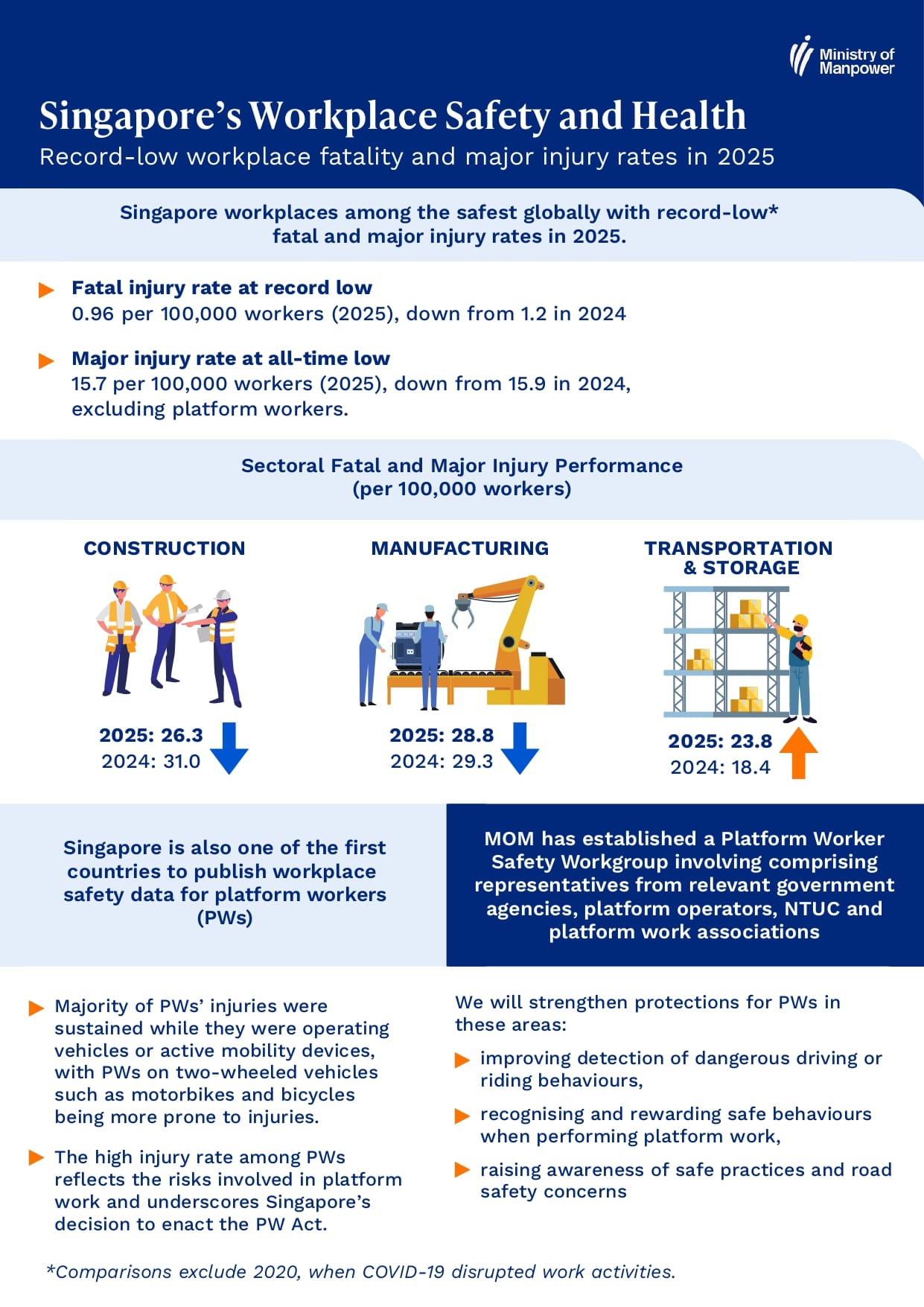
In contrast, the Transportation & Storage sector saw its workplace fatal and major injury rate rise to 23.8 per 100,000 workers in 2025, up from 18.4 in 2024. Slips, trips and falls, along with vehicular incidents, remained the leading causes of fatalities and injuries in the sector.
Platform worker safety in focus
The report also highlighted safety risks among platform workers, particularly those involved in delivery services. In 2025, there were two fatalities and 74 major injuries involving platform workers, translating into a fatal and major injury rate of 84.6 per 100,000 platform workers.
Most injuries occurred while workers were operating vehicles or mobility devices on public roads and paths, with those using two-wheeled vehicles such as motorbikes and power-assisted bicycles more prone to injuries.
Singapore is among the first countries to introduce statutory protections for platform workers, which took effect in January 2025. These protections include injury compensation coverage and safety protections under workplace safety laws, requiring work-related injuries involving platform workers to be reported and monitored.
Authorities also introduced a code of practice for platform services and formed a Platform Workers Trilateral Group in 2025 to strengthen safety protections. A new Platform Worker Safety Workgroup has since been established to study risk factors and develop further safety measures, including safety incentives, improved detection of unsafe behaviour and greater road safety awareness.
Continued focus on safety culture
Despite the record-low injury and fatality rates, authorities stressed that continued vigilance is necessary as workplace risks evolve with economic activity and new forms of work.
Officials said sustaining workplace safety improvements will require employers, contractors and workers to continue prioritising safety and embedding it into daily work practices, supported by technology adoption and stronger risk management capabilities.
Author
Loading...