








Economy Policy
Starbucks faces lawsuit over DEI policy accused of race-based hiring and promotion



 ||
||


Starbucks says the authorities had not identified any individual who suffered an adverse employment action due to its DEI initiatives, calling the allegations speculative.
Starbucks, one of the world’s most recognisable coffee brands, has become the latest flashpoint in the escalating backlash against diversity, equity and inclusion (DEI) policies in the United States.
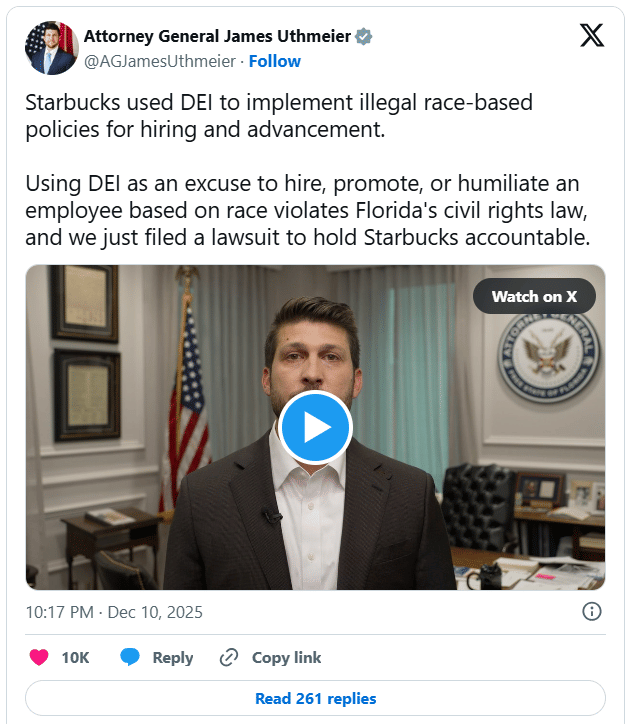
Florida’s Attorney General James Uthmeier has filed a lawsuit accusing the Seattle-based coffee chain of turning DEI from a corporate value into what he calls a “mandatory hiring and promotion system based on race.”
The suit alleges that Starbucks has enforced race-based quotas for hiring, pay and advancement—practices the state claims violate Florida’s civil-rights law.
“Starbucks made DEI more than a slogan,” Uthmeier said in a video statement shared on social media. “They set numerical racial targets for their workforce and tied executive bonuses to those targets. That is brazen discrimination, and it is against the law. DEI can never be an excuse to violate someone’s civil rights.”
What Florida is alleging
The 21-page complaint claims that Starbucks has maintained racially discriminatory employment practices for at least five years. According to the lawsuit, the company allegedly:
Hires applicants based on race through quotas and numerical goals
Pays employees different wages based on race or ethnicity
Links executive compensation to participation in mentorship programmes limited to “favoured” racial groups
Excludes employees of certain races from networking and development opportunities
The state argues these practices disadvantage what it calls “non-favoured races,” including White, Asian and multiracial employees, resulting in lost job opportunities, denied promotions, reduced pay and exclusion from career development initiatives.
Florida is seeking civil penalties that could run into tens of millions of dollars, or more, under state law, which allows fines of up to $10,000 per violation. The lawsuit also seeks compensatory damages for mental anguish and loss of dignity, although it does not name specific individuals allegedly harmed.
Starbucks pushes back
Starbucks has strongly denied the allegations. “We disagree,” a company spokesperson told Bloomberg Law. “We are deeply committed to creating opportunity for every single one of our partners. Our programs and benefits are open to everyone and lawful.”
The company maintains that its hiring practices are inclusive, fair and competitive, and designed to ensure the strongest candidate is selected for every role. On its website, Starbucks says expanding workforce diversity helps bring new perspectives that strengthen its culture and performance.
As of 2024, nearly half of Starbucks’ workforce (47.8%) is White, while 31.7% is Hispanic or Latinx and 8.1% is Black, according to company data.
A familiar legal battle
This is not the first time Starbucks has faced accusations of racial discrimination.
In 2023, the company was ordered to pay $28.3 million to a former regional director, Shannon Phillips, who claimed she was wrongfully terminated for being White following a high-profile 2018 incident involving the arrest of two Black men in a Philadelphia Starbucks.
That episode prompted nationwide protests, a public apology from Starbucks’ CEO, company-wide racial bias training, and the introduction of an open-door policy, later scaled back earlier this year.
In the current Florida case, Starbucks argues the state has failed to demonstrate actual harm. In an earlier administrative filing, the company said authorities had not identified any individual who suffered an adverse employment action due to its DEI initiatives, calling the allegations speculative.
DEI under global scrutiny
The lawsuit comes amid growing political and corporate pushback against DEI programs in the US and beyond. In recent years, companies including Google, Amazon, Walmart, McDonald’s and Accenture have either scaled back or rebranded their DEI efforts following legal challenges and consumer criticism.
Even organisations headquartered outside the US but with significant American operations have begun reassessing their approach.
Angelica Hunt, head of marketing at Australia-based TDC Global, has previously described the moment as one of “polarisation.”
“What we’re seeing isn’t necessarily a scaling back of effort,” Hunt said, “but a redistribution of resources, and a messaging shift.”
According to her, many organisations are now emphasising “inclusion” over “diversity” because it is perceived as easier to defend in a charged political climate.
As the Starbucks case moves forward, it is likely to become another bellwether for how far companies can go in designing DEI strategies, without crossing the increasingly contested legal and political lines around race, fairness and opportunity in the workplace.
Author
Loading...