








Leadership
Women hold 43% of senior HR roles, followed by CFO at 39% and CMO at 29.7%







Women now hold 23.8% of global CEO roles, up 2.1 points from 2025, with representation also rising in CCO, CIO and CSO positions despite an overall leadership dip.
Gender equality initiatives continue to gain traction across the global mid-market, with new data showing that most companies still see diversity as a driver of growth and competitiveness, even as the share of women in senior leadership roles dips slightly in 2026.
According to the Women in Business 2026 report by Grant Thornton, 92.7% of mid-market firms now have DE&I initiatives in place, and 75.8% say they remain committed to gender equality programmes, despite shifting global conversations around diversity.
More than 36.8% of businesses plan to introduce new gender-equality measures, signaling that many companies still view inclusion as a strategic priority rather than a compliance exercise.
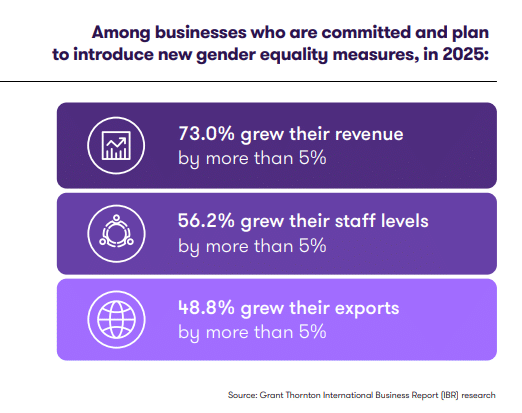
The data also suggests a strong link between gender equality and business performance. Among companies committed to introducing new gender-equality measures, 73% reported revenue growth of more than 5% in 2025, while 56.2% expanded their workforce by more than 5% and 48.8% increased exports by the same margin.
“Gender equality is no longer just a values-driven initiative,” said Jenn Barnett, Director of Inclusion and Diversity at Grant Thornton UK. “Diverse senior teams can reduce blind spots and outperform on client engagement and risk management when psychological safety exists.”
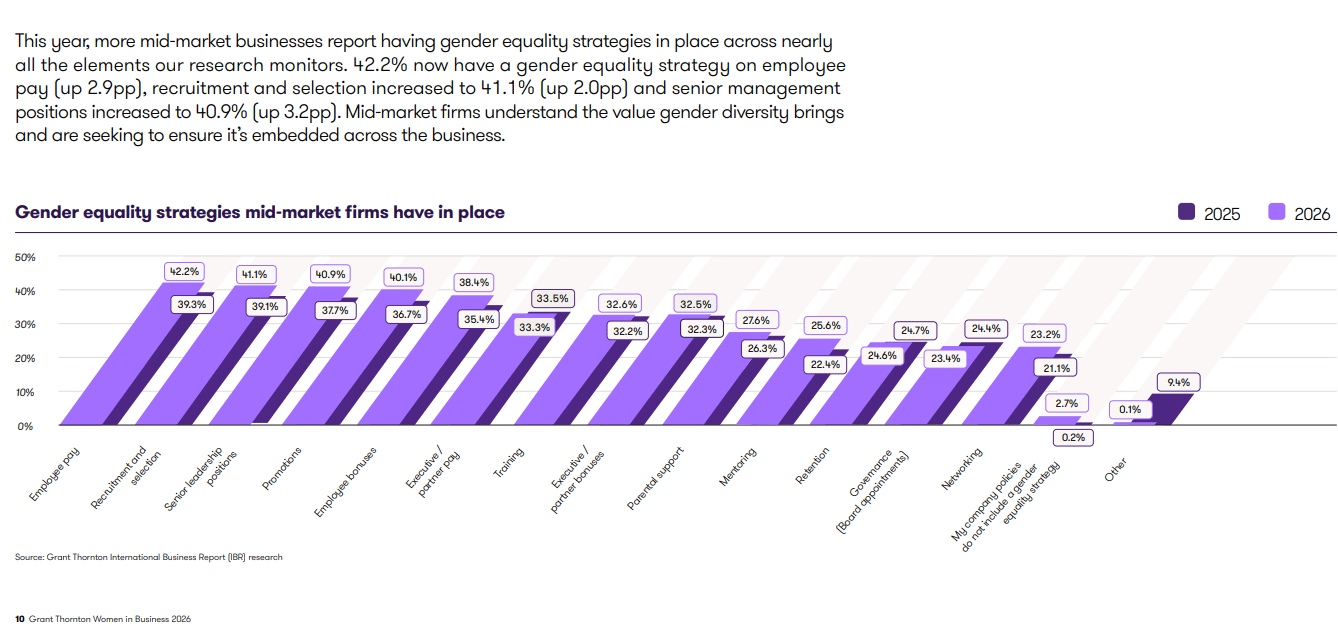
Mid-market leaders themselves recognise these advantages. Around 22.1% say gender-diverse leadership drives innovation, 19.5% believe it leads to better decision-making, and 18.8% link it to improved financial performance, capabilities that are increasingly critical in a volatile global economy.
At the same time, investors and job candidates are placing greater scrutiny on leadership diversity. In the past year, 26.5% of businesses reported that potential investors requested information on gender balance in leadership teams, while 91.9% of mid-market leaders say they personally consider gender equality initiatives when evaluating potential employers.
Yet progress at the top has slowed. The global share of women in senior management positions fell to 32.9% in 2026, down 1.1 percentage points from 34.0% last year. While fluctuations are common, the dip underscores how fragile gains in representation can be.
Over the past two decades, female representation in senior leadership has still risen by 13.4 percentage points, and the long-term trend suggests that gender parity could be reached by 2051 if momentum continues.
Another worrying sign is the increase in organisations with all-male leadership teams, which rose from 4.1% to 5.7% this year. Still, some countries, including India, Colombia, Vietnam, and South Africa, reported no businesses with entirely male leadership teams, highlighting regional progress.
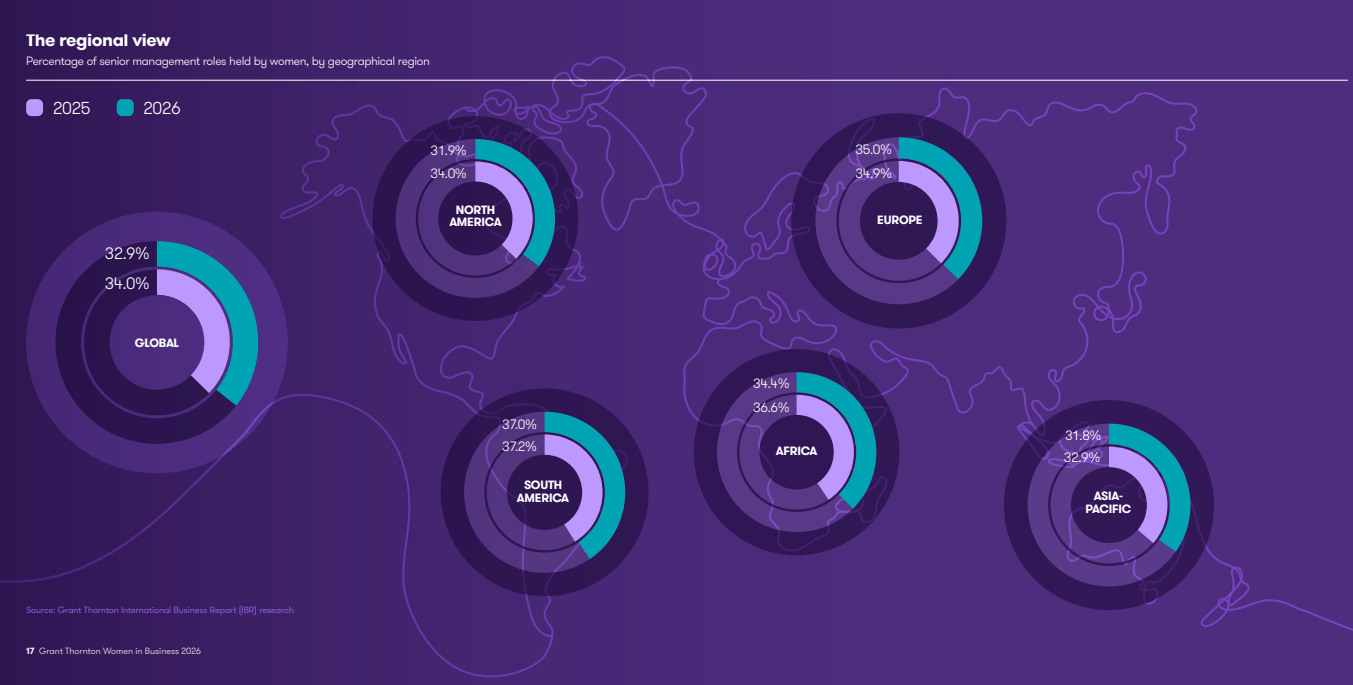
Regionally, South America continues to lead with 37% of senior roles held by women, while Asia-Pacific remains the lowest at 31.8%, weighed down by lower representation in countries such as South Korea and Japan. However, Japan recorded notable progress, increasing female leadership representation by 3.1 percentage points, pushing it above 20% for the first time.
Despite the overall decline in representation, women are gaining visibility in some of the most influential roles. Women now hold 23.8% of global CEO positions, up 2.1 percentage points from 2025, while representation is also rising in roles such as Chief Commercial Officer, Chief Information Officer and Chief Sustainability Officer.
Human Resources remains the most female-represented senior function at 43%, followed by Chief Financial Officer roles at 39% and Chief Marketing Officer positions at 29.7%.
These visible leadership roles can create a ripple effect across organisations, experts say. “Successful female role models in strategic senior roles demonstrate that organisations perform better with balanced gender representation,” said Dan Holland, Partner at Grant Thornton Ireland.
For mid-market companies, the stakes are high. Nearly 47.6% of firms report a shortage of finance as a constraint, and stronger diversity credentials could help improve access to capital while attracting senior talent, particularly as some large corporations scale back DE&I initiatives.
Ultimately, the report argues that gender equality must move beyond standalone initiatives and become embedded in leadership behaviour, strategy and operations.
The report concludes that gender-balanced leadership is not only a question of fairness but a driver of innovation, resilience and growth. For the global mid-market, the sector often described as the engine of the world economy, maintaining momentum on gender diversity could prove decisive for long-term competitiveness.
Author
Loading...