








Organisational Culture
Singaporean worker struggles with strained colleague relationships after early promotion






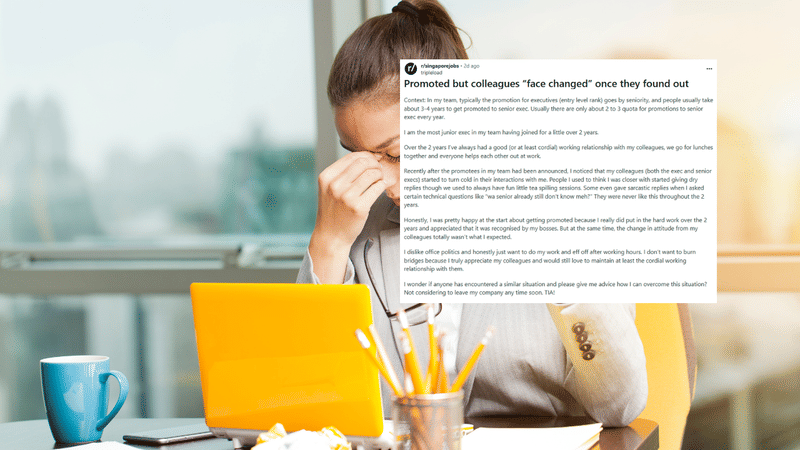
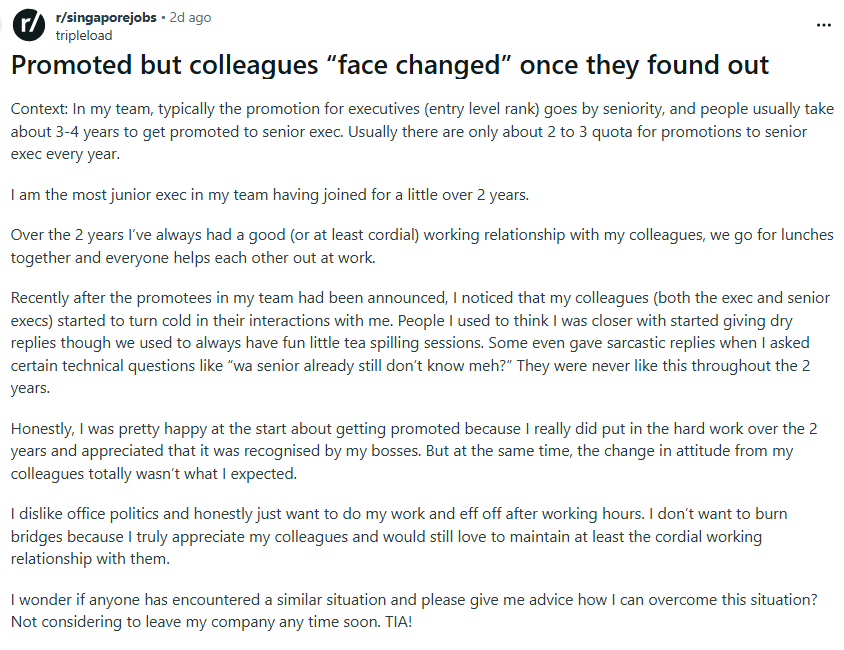
Colleagues, who previously shared friendly lunches, casual conversations and “tea-spilling” sessions with her, had become distant and curt. Dialogues that were once warm turned dry, and familiar camaraderie gave way to awkwardness
A Singaporean employee has shared her distress over worsening workplace relationships after receiving an early promotion, sparking a wider online discussion about office dynamics, jealousy, and professionalism.
The woman recounted her experience on the r/singaporejobs forum on Saturday, seeking advice from fellow locals after noticing a marked shift in how her colleagues treated her following her promotion.
According to her post, she had felt proud to be promoted after just two years with the company, a milestone that typically takes three to four years for most employees to achieve. Her sense of accomplishment, however, was soon overshadowed by an unexpected change in workplace behaviour.
“Honestly, I was pretty happy at the start about getting promoted because I really did put in the hard work over the two years and appreciated that it was recognised by my bosses,” she wrote. “But the change in attitude from my colleagues totally wasn’t what I expected.”
She said colleagues she previously shared friendly lunches, casual conversations and “tea-spilling” sessions with had become distant and curt. Responses that were once warm turned dry, and familiar camaraderie gave way to awkwardness.
In some cases, she was met with sarcasm when asking technical questions related to her role, something she said had never happened before.
“[They would say things like], ‘Wa, a senior already still don’t know meh?’ They were never like this throughout the two years,” she shared.
Despite the discomfort, the woman stressed that she had no interest in office politics and had no plans to leave her job.
“I dislike office politics and honestly just want to do my work and eff off after working hours,” she wrote. “I don’t want to burn bridges because I truly appreciate my colleagues and would still love to maintain at least a cordial working relationship with them.”
Ending her post on a note of uncertainty, she asked if others had experienced similar situations and sought advice on how to navigate the growing tension at work.
The post quickly drew responses, with many redditors reminding her to separate professional goals from personal validation. One user wrote, “You work for money, and these people are just colleagues. You don’t need to care so much. Just focus on your career.”
Another commented, “Most people will wish you success in the world and then hate you for it. They’re not worth the headspace you’re allocating for.”
Several users suggested the shift in behaviour could be linked to the speed of her promotion, with colleagues potentially feeling jealous or questioning her readiness for the role.
Whatever the reason, redditors largely agreed that professionalism should remain the priority. “Although a lot of people are of the view your colleagues are not your friends, they are not your enemy either,” one redditor wrote. “Work with them so that they contribute to your objectives and KPIs. For those who throw spanners in the works, that’s part and parcel of work life.”
Another echoed the sentiment: “At work, continue to be cordial and professional. Outside of work, help them as a fellow human being would.”
The discussion highlights a common but often unspoken challenge in workplaces, and at a ground level, HR can play a critical role in preventing such transitions from turning isolating for newly promoted employees.
First, HR teams can work with managers to prepare teams before promotions are announced, especially when someone is elevated ahead of peers. Clear communication around role expectations, business rationale, and performance benchmarks can reduce speculation and resentment.
Second, HR leaders can encourage structured role-transition conversations way ahead. Newly promoted employees often shift from peer to near-manager roles overnight, without guidance on how to reset boundaries. Facilitated check-ins, both with the promoted employee and their immediate team, can help normalise the change and surface tensions early.
Third intervention is manager capability building, especially emotional and social impact of promotions on team dynamics. HR can equip managers with tools to address subtle behaviours such as sarcasm, withdrawal, or exclusion, issues that rarely show up in formal complaints but can erode morale over time.
Fourth, HR can also reinforce psychological safety norms, making it clear that asking questions is not a sign of incompetence, regardless of seniority. This can be done through team charters, meeting norms, or leadership modelling, where senior staff openly admit gaps and learning curves.
Finally, HR leaders can create safe feedback channels, informal pulse check-ins, skip-level conversations, or anonymous listening tools, allowing employees to raise concerns before frustrations escalate into disengagement or attrition.
Author
Loading...