








Strategic HR
Fire 90% of HR: Amanda Goodall’s viral tweet employees couldn’t stop sharing





A viral post questioning HR’s value has ignited a fierce debate, exposing post-layoff anger and a deep trust deficit in workplaces.
A single sentence lit the fuse.
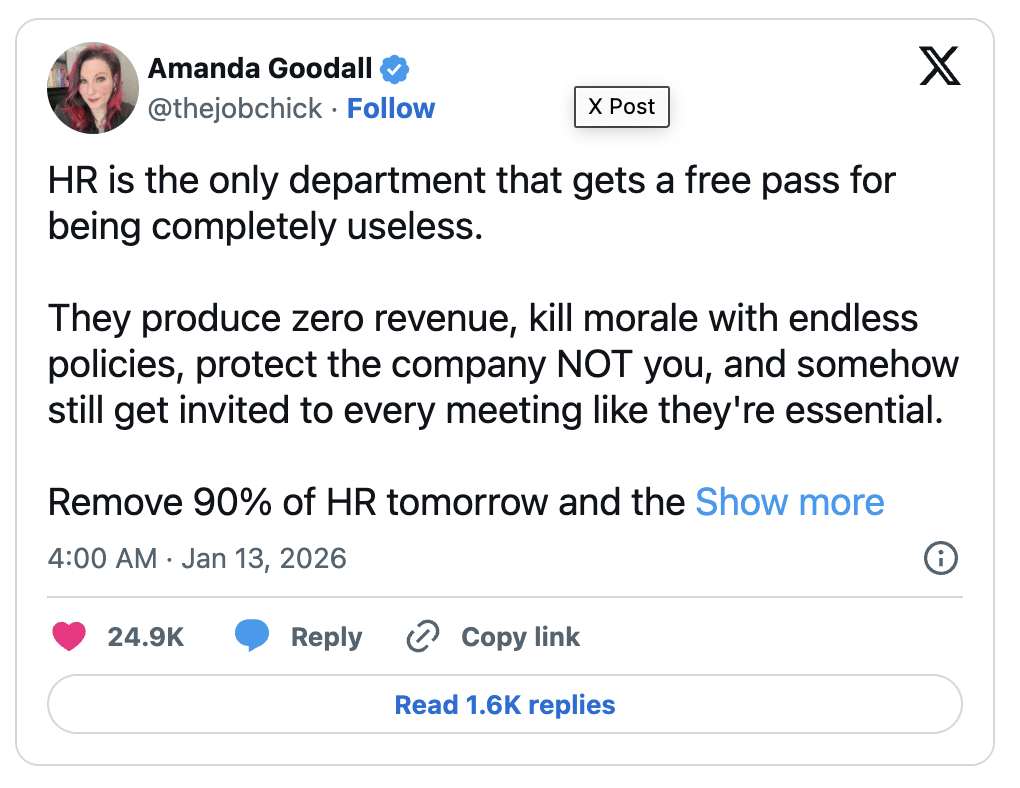
“Remove 90% of HR tomorrow and the business would run smoother, faster, and happier.”
That line, posted this week by workforce strategist Amanda Goodall on X, formerly Twitter, has detonated across corporate America, triggering one of the loudest and most polarising debates about the role of Human Resources in years.
Goodall, known online as @thejobchick, accused HR departments of producing no revenue, suffocating morale with policy and serving the company, not employees. The post went viral within hours, spilling across X, LinkedIn and private executive forums, as workers and managers shared their own experiences.
The speed and scale of the backlash surprised even seasoned observers of workplace culture. Many said the message resonated because it captured a grievance simmering since the pandemic-era boom gave way to mass layoffs and cost cutting.
In recent years, HR has increasingly become the public face of corporate retrenchment. Redundancies delivered over video calls, return-to-office mandates framed as “culture”, and AI-driven efficiency pushes have often been communicated by HR teams, even when decisions were taken at board level.
That visibility has come at a cost.
Goodall’s claim that “HR protects the company, not you” struck a nerve because it reflects the function’s structural reality. HR reports to leadership. Its mandate is risk management, compliance and consistency, not employee advocacy — a distinction that becomes painfully clear during downturns.
The backlash also revived a harder question about value. In a corporate environment obsessed with measurable output, HR’s contribution is harder to quantify than revenue or product delivery. Critics argue the function expanded during years of cheap capital, layering processes and roles that now feel disconnected from frontline work.
HR leaders pushed back swiftly, warning that stripping back people teams would expose companies to legal, cultural and operational risk. Many argued that HR’s work is invisible when it succeeds — and most visible when it is asked to deliver bad news it did not design.
Yet analysts say the intensity of the reaction suggests this was never just about HR.
The debate has become a proxy for deeper workplace discontent: employees who feel disposable, executives under pressure to cut relentlessly, and a growing cynicism towards corporate language that promises empathy while enforcing austerity.
Rather than signalling the death of HR, the episode may accelerate its reinvention. Companies are already experimenting with leaner people teams, embedding HR partners directly into business units or splitting compliance from employee advocacy roles.
Goodall ended her post with a challenge — “change my mind” — but the response suggests the argument has already shifted. In a post-layoff, AI-accelerated economy, even long-protected corporate functions are no longer immune from scrutiny.
Topics
Author
Loading...