








Talent Management
40,000 Samsung workers protest pay, threaten strike as AI demand boosts profits





Union warns of 18-day walkout as employees demand higher bonuses despite strong chip profits.
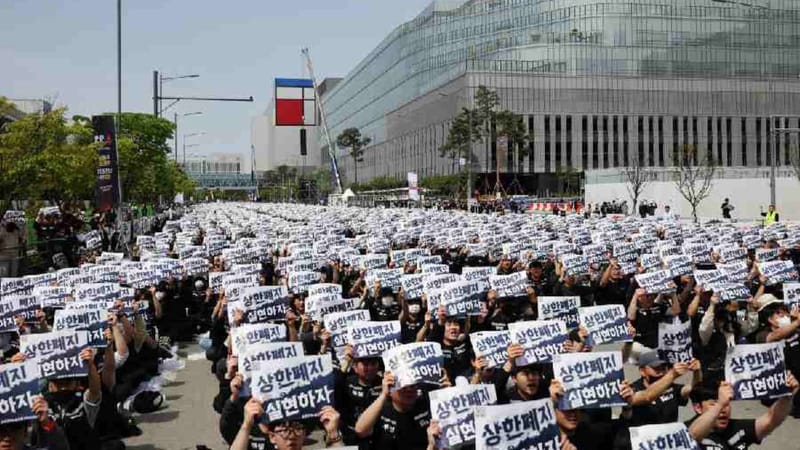
Around 40,000 workers at Samsung Electronics rallied at a semiconductor complex in Pyeongtaek, South Korea, demanding higher bonuses and warning of a strike as booming demand for artificial intelligence continues to lift memory chip profits.
The protest, held amid a heavy police presence, saw workers chanting slogans and calling for greater transparency in compensation and the removal of caps on bonuses, Reuters reported. Police did not provide an official estimate of the crowd.
Pay dispute intensifies despite strong profits
The rally comes at a time when Samsung’s semiconductor business is benefiting from surging global demand for AI infrastructure.
The company earlier forecast record first-quarter operating profit of 57.2 trillion won, driven in part by higher demand for memory chips, Reuters reported. Samsung, alongside SK Hynix, accounts for roughly two-thirds of global memory chip production.
On the same day, SK Hynix reported record quarterly revenue and operating profit for the January to March period, attributing the growth to rising investments in data centres and AI systems.
Union rejects bonus structure
Samsung’s labour union, which represents around 74,000 workers, said the company had failed to provide adequate compensation despite strong financial performance.
The union has rejected management proposals that included bonuses in the form of restricted stock, instead demanding higher cash bonuses and removal of bonus caps.
“We won’t stop this fight until our fair demands are met,” union leader Choi Seung-ho said during the protest, speaking from a crane-mounted structure.
Strike threat raises stakes
Union officials have warned of an 18-day strike starting May 21 if negotiations with management fail.
They estimate that such a walkout could cost Samsung more than 1 trillion won per day, highlighting the potential operational and financial impact of prolonged industrial action.
Industry tailwinds and risks
The dispute comes amid a broader upswing in the semiconductor sector, driven by AI-led demand for advanced computing infrastructure.
However, uncertainties remain. Reuters reported that geopolitical tensions, including conflict in the Middle East, have disrupted supplies of key materials such as helium and increased energy costs, adding pressure to the industry outlook.
The standoff at Samsung underscores growing tensions between labour and management in sectors benefiting from AI-driven growth.
As profits rise, workers are seeking a greater share of gains, setting up a critical test for how large technology companies balance cost control, workforce expectations and sustained investment in AI-led expansion.
Topics
Author
Loading...
Loading...