








Wellbeing
Philippines officially allows flexible work schemes for private firms amid Middle East crisis







DOLE notes that industries such as mining, agriculture, and manufacturing may face operational challenges in adopting remote or hybrid work arrangements, limiting the scope of flexible work policies.
The Department of Labor and Employment (DOLE) has encouraged private sector employers to consider flexible work arrangements as rising oil prices linked to the Middle East crisis drive up operational costs.
The advisory, published on March 17 on the official website, follows a directive from Ferdinand R. Marcos Jr. to conserve energy and reduce fuel consumption, prompting businesses to explore alternatives such as compressed workweeks and remote work setups.
Under a compressed workweek scheme, companies may distribute the standard 40-hour work schedule across four days instead of five, potentially suspending operations on Fridays. Meanwhile, work-from-home arrangements allow employees to complete part of their workweek remotely, depending on job requirements.
DOLE Spokesperson Assistant Secretary Lennard Constantine C. Serrano stressed that such arrangements must be based on mutual agreement between employers and workers and should comply with existing labor laws and occupational safety standards.
“Any agreement must adhere to the Labor Code and general labor standards, ensuring that workers’ benefits are not diminished,” Serrano said.
Echoing this, Alvin B. Curada, Director of the Bureau of Working Conditions, emphasized that employees should continue receiving their regular wages and benefits even under alternative work setups.
The department noted that guidelines for flexible work arrangements have been in place since 2004, with policies covering compressed workweeks, worker rotation, and flexi-time schedules. Remote work arrangements were later formalised under the Telecommuting Act and reinforced through subsequent regulations.
However, DOLE acknowledged that not all industries can adopt such measures. Sectors like mining, agriculture, and manufacturing may face operational constraints in implementing remote or hybrid work models.
Curada added that while a four-day workweek could support energy-saving efforts, its adoption should be carefully assessed to ensure it does not affect productivity or worker welfare.
Employers who opt to implement flexible work arrangements are required to report these changes through DOLE’s online compliance system. Meanwhile, workers with concerns can seek assistance through regional DOLE offices or via the department’s Hotline 1349, which operates on weekdays.
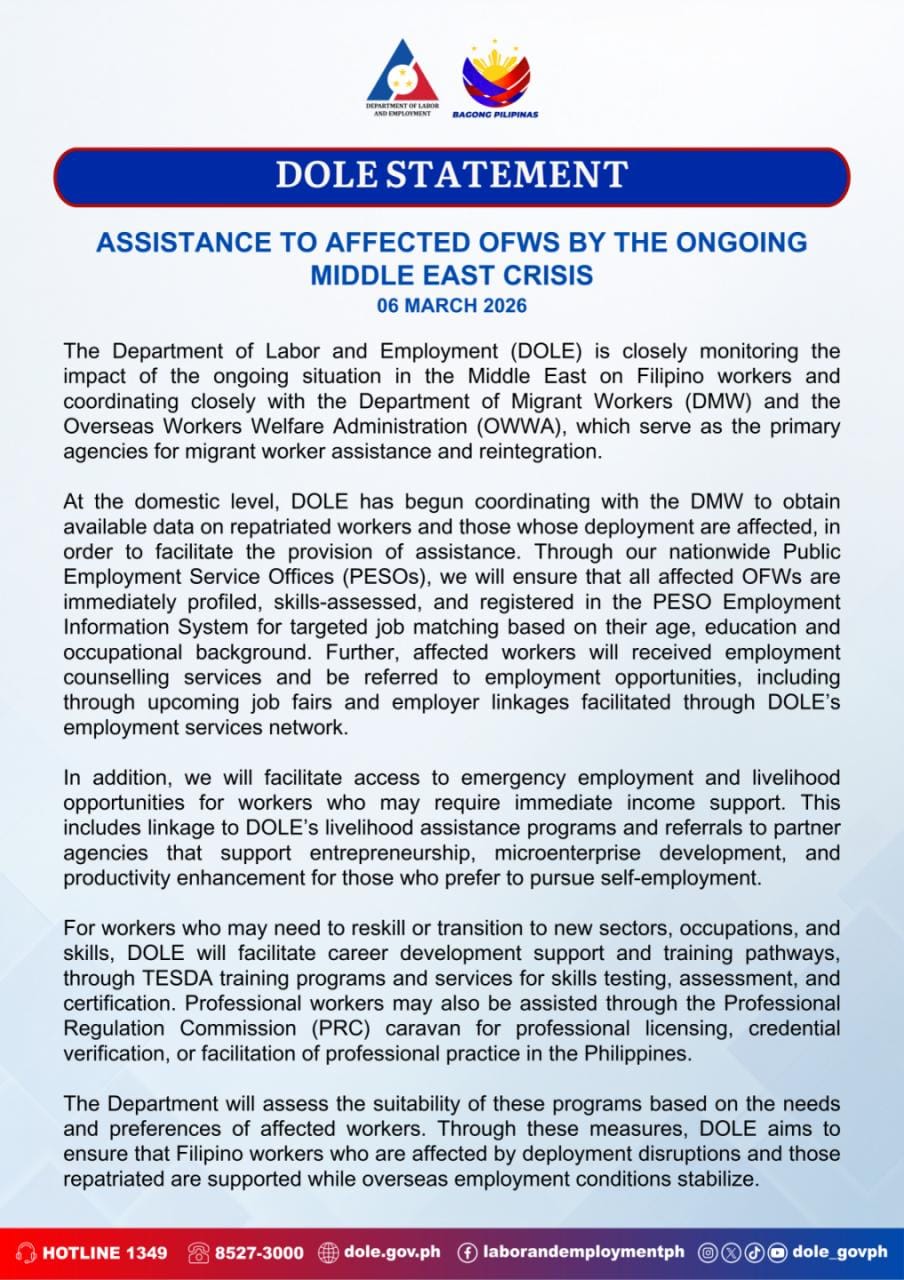
The department is also coordinating efforts to support Filipino workers affected by the Middle East crisis, including profiling, job matching, and counselling through employment offices. The support also includes access to emergency jobs, livelihood programs, and skills training to help displaced and repatriated workers secure income and transition to new opportunities.
Author
Loading...