








Strategic HR
Bridging the gap between learning and performance through experiential simulations





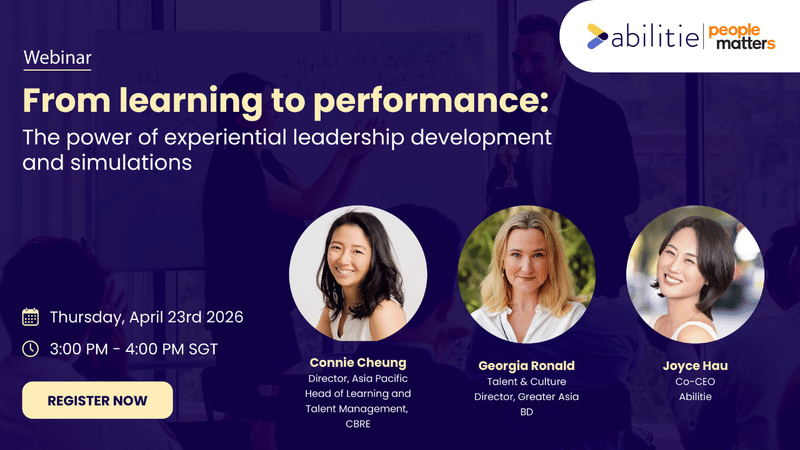
Simulation-led experiential learning is emerging as a critical tool for organisations seeking stronger leadership capability, decision-making, and performance.
As organisations demand faster, more adaptive, and business-aligned leadership capability, traditional leadership development approaches are being questioned. Research shows that these programmes struggle to create sustained behavioural change when learning remains disconnected from real-world workplace application.
While leaders are expected to navigate ambiguity, manage complex people dynamics, and make decisions under pressure, many organisations rely on knowledge-first learning formats, which are detached from operational realities.
This formed the backdrop of the People Matters webinar, “From Learning to Performance: The Power of Experiential Leadership Development and Simulations,” hosted in association with Abilitie. The discussion brought together Connie Cheung, Director, Asia Pacific Head of Learning and Talent Management at CBRE; Georgia Ronald, Talent & Culture Director, Greater Asia at BD; and was moderated by Joyce Hau, Co-CEO, APAC at Abilitie, to examine why simulation-led experiential learning is gaining momentum across organisations seeking measurable leadership impact.
A recurring theme throughout the discussion was that the challenge is no longer access to knowledge but whether leaders can apply judgment and make decisions effectively in real-world scenarios.
Why organisations are shifting from knowledge to practice
Experiential learning is gaining momentum because leadership today is increasingly defined by action rather than information retention. Simulations create safe-to-fail environments where leaders can practise difficult conversations, strategic trade-offs, enterprise thinking, and people management decisions before facing them in real business contexts.
For Joyce, this shift has been intentional. Abilitie’s learning philosophy, she explained, focuses on “the art of practice, not just theory,” moving beyond “passively taking information” toward leaders “really getting our hands on it in a safe-to-fail environment.”
That distinction matters because leadership capability is ultimately tested under pressure, in moments involving conflicting priorities, uncertain information, or sensitive people situations. Simulations recreate those conditions in ways that traditional classroom learning often cannot.
Simulations to solve business-critical problems
For both CBRE and BD, simulation-led learning was introduced not as a trend, but as a response to tangible business challenges.
At CBRE, the shift accelerated during the COVID-19 period, when leadership pressures intensified across distributed teams. Connie explained that the organisation had observed rising attrition and increasing pressure on managers trying to engage teams during uncertain conditions.
What managers needed was not additional frameworks or more content, but opportunities to practise leadership behaviours in practical situations. CBRE introduced a blended leadership programme using Abilitie’s Management Challenge simulation to help managers rehearse conversations, decision-making, and engagement strategies in a practical environment.
At BD, the challenge centred around manager consistency. “You're getting a real mixed bag of capability when you recruit external leaders,” said Georgia. “We wanted to level-set that foundational capability that they're coming in with.” Simulations became a way to standardise management capabilities while also developing broader enterprise skills such as strategic thinking, influencing, and financial acumen among future leaders.
Simulations create social learning
Another major differentiator was the collective nature of simulation-based learning. Leadership development is often treated as an individual activity, yet leadership itself is highly social and relational. Simulations changed that dynamic by creating shared learning experiences and building psychological safety amongst participants.
This became especially important in helping leaders discuss challenges they would otherwise struggle to share openly. Joyce observed that “managing can be a really lonely experience,” particularly when managers are navigating sensitive people situations without peer support.
Connie noted that the simulations created unexpected moments of openness and reflection, as inside highly performance-driven environments, managers found that their peers were also facing similar pressures.
How AI is extending experiential learning
The conversation also explored how AI-enabled simulations are expanding leadership practice into areas traditionally difficult to rehearse safely. Both leaders described strong adoption of AI-supported leadership conversations, particularly for feedback discussions, performance concerns, and employee engagement scenarios.
At CBRE, AI-based scenarios were used to help managers practise difficult conversations without fear of real-world consequences. The addition of language localisation significantly strengthened adoption across the Asia Pacific markets. Managers were able to practise conversations in their own native languages, making the experience more realistic and emotionally relevant.
When behaviour change becomes visible
One of the clearest indicators of impact discussed during the webinar was immediate behavioural change. Connie shared a striking example from a recent session, where a participant’s direct report approached her the next morning. “She said, ‘That’s my manager there. He spoke to me differently yesterday. Something happened.’” The employees encouraged the programme because “we all can feel it.”
Such examples reinforced the central argument of the session: simulations work because they create immediate reflection and application. Managers often left sessions already planning concrete actions, from booking one-on-one meetings to initiating new conversations to reassessing how they engaged team members.
According to Connie, these shifts often emerged when managers recognised that different team members required different motivators, communication styles, and levels of support.
In the end, speakers stressed that sustaining behavioural change required ongoing reinforcement. “You can’t just have an intense three-day workshop and then just let them go,” Connie said. “You need elements that are going to help them sustain.”
At CBRE, this included accountability groups, follow-up learning journeys, and AI-supported practice sessions after workshops concluded. Managers were expected to schedule peer accountability meetings before leaving the programme itself.
BD similarly embedded simulations into broader leadership journeys rather than treating them as standalone interventions. Georgia emphasised that learning effectiveness increased when simulations were integrated with workshops, peer learning, and organisational leadership frameworks.
Leadership development remains fundamentally human
Despite the rise of AI, digital learning, and immersive technologies, the session repeatedly returned to one core idea: leadership development remains deeply human.
“Words like empathy, judgment, and collaboration require practice,” Connie stated. Simulations, the speakers argued, create the conditions for leaders to build those capabilities deliberately, through experimentation, reflection, collaboration, and feedback.
Georgia described this as “exercising that judgment muscle,” particularly in situations involving trade-offs, uncertainty, and consequences.
Watch the full video here.
Topics
Author
Loading...