









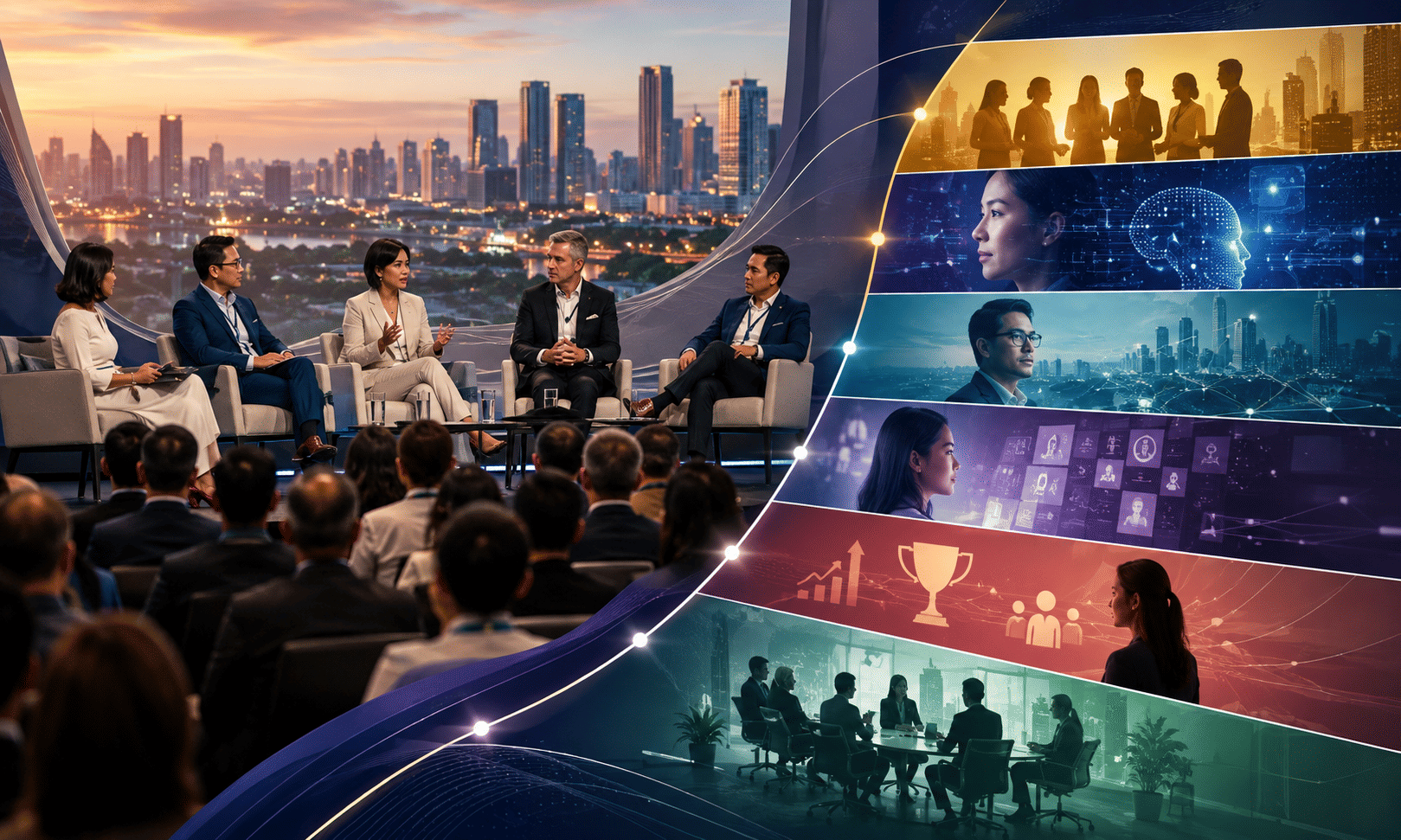
A conference agenda is most useful when the conversations build on each other.
For the Philippines, that matters particularly now. AI is changing the economics of work, employers are competing for capabilities that did not sit on workforce plans a few years ago, young talent wants faster growth and greater agency, and HR leaders are being asked to influence productivity and organisation design alongside the traditional people mandate.
TechHR Pulse Philippines 2026 has therefore been built around a progression rather than a collection of disconnected HR topics. Under the theme “Championing Change: Powering the Next Chapter of Growth Through People, AI and Leadership,” the conversations on 8 September will move across four interconnected areas: economic transformation, enterprise transformation, workforce and human transformation, and leadership transformation.
The official conference agenda positions these as the forces shaping how the Philippines can unlock greater value from its human capital, scale intelligent technologies, redesign jobs and capabilities, and build leaders equipped to navigate continuous change.
Explore the TechHR Pulse Philippines 2026 agenda
The day begins with a bigger question: What should the Philippines compete on next?
Before HR leaders can decide which skills to build or technologies to buy, there is a larger economic question to answer: what kind of work should the Philippines be preparing to win?
That is where the opening conversations begin. The Power Panel, “Beyond Cost Advantage – Building the Philippines as ASEAN’s Top Knowledge Economy,” puts national competitiveness before functional HR. Annie Caw, CHRO at CIMB Bank Philippines; Tina Alvarez, CDIO at JG Summit Holdings; and Amit Narain, Human Resources Director at Nestlé Philippines, with Jonathan Tam of Foodpanda chairing the conversation, will examine how the country can build on its established strengths in talent and services while moving towards higher-value capability, stronger productivity and innovation.
It is a useful starting point because the Philippines’ future talent story cannot rely indefinitely on the same proposition that built the previous one. The opportunity now is to create deeper capability in areas where human judgement, digital fluency, problem-solving and specialist expertise carry greater value.
That national lens also gives the rest of the agenda a purpose. Skills matter because the economy is moving up the value chain. AI matters because it changes how that work gets produced. Leadership matters because neither transition happens simply by announcing a strategy.
Then comes the capability question: Are we preparing people for work that is actually emerging?
Once the economic ambition is clear, the conversation moves closer to the workforce.
In “The Skills Reset: Building Capability for a Workforce in Transition,” Rowena Subido of RCBC, Ben Marasigan of McDonald’s Philippines and Dante Crisostomo of Dentsu, moderated by Dr. Marvin Zoilo of Tech Mahindra, will approach capability-building from three very different workforce environments: financial services, a large frontline business, and a fast-changing creative and digital organisation.
That diversity is important. A skills-first strategy cannot mean the same thing for every organisation, and the Philippines needs approaches that work for both large professional workforces and the millions of employees whose jobs are operational, customer-facing or early in their career journey.
The sharper questions are therefore not simply how much organisations are investing in learning, but how they know which capabilities matter next, when to build versus buy talent, how internal mobility can become real rather than aspirational, and how young employees can move from learning tasks to owning outcomes.
The agenda deliberately connects skills with workforce and human transformation, rather than treating learning as an isolated L&D challenge. The official conference framing emphasises changing jobs, career pathways, AI literacy, trust and adaptability as parts of the same workforce transition.
AI moves from the tool conversation to the organisation conversation
AI will run through the day, but the agenda does not treat it as a standalone technology showcase.
That distinction matters. Jason Averbook, Co-founder of Now to Next, is among the global voices leading the programme, bringing a proposition that has increasingly defined the AI-at-work conversation: organisations need to redesign how work happens rather than simply place new technology on top of old processes. People Matters’ programme positioning notes that Averbook will deliver both a keynote and an exclusive workshop for attendees.
The enterprise transformation conversations take that thinking further. From moving AI beyond experimentation to understanding how workforce data can improve decisions, the agenda asks what happens when technology becomes part of the operating model.
One practical example comes through Hans Montenegro, CHRO and Head of Corporate Services at Meralco, whose case-led conversation will look at how HR can move beyond AI experimentation by working with technology and business teams to identify valuable opportunities, redesign processes and prepare people for the transition. People Matters has positioned that discussion around a simple but demanding test: how does AI move from pilots to measurable impact?
The Think Tank Panel, “Smart Payroll, Smarter Hiring: Winning the Talent Lifecycle with Technology and Workforce Data,” pushes the data conversation into another part of the employee journey. Jaquelyn Barrios of Genpact, Vikas Goel of Ramco Systems and Keene Saul of Sutherland, with Monde Nissin’s Sheila Pangilinan moderating, will examine what changes when hiring, payroll and workforce operations stop functioning as disconnected systems.
For leaders, the significance is broader than HR-process integration. Connected data can provide better visibility into talent supply, workforce cost, compliance, employee experience and the patterns shaping retention and deployment. The discussion therefore sits at the intersection of technology and workforce intelligence rather than simply recruitment or payroll.
The middle of transformation is where trust, managers and culture become decisive
Technology and skills can redesign the mechanics of work, but organisations still experience change through people.
The fireside conversation, “The New Leadership Playbook: Leading Through Uncertainty and Change,” will bring together Karen Angeli Diaz of Schneider Electric and Beng Cortes of Maxicare Healthcare Corporation, moderated by Tala’s Mia Lim, to focus on the leadership behaviours required when leaders cannot offer perfect certainty.
That conversation is especially relevant because the manager is often where transformation becomes real. Leaders may announce strategy at the top, but employees experience it through how their manager explains a decision, handles ambiguity, sets expectations and responds when pressure rises.
Culture enters the agenda from a distinctly Filipino perspective as well. The idea of Bayanihan—collective responsibility and carrying a burden together—creates a useful counterpoint to change programmes where responsibility is announced collectively but execution is quietly pushed down the hierarchy. The broader question for leaders is whether trust and community inside Philippine organisations can be translated into shared accountability, voice and ownership, rather than remaining values that appear primarily in culture statements.
That is what makes the cultural strand different from another engagement discussion. It asks how local strengths can become practical organisational advantages.
Rewards reveal what an organisation actually values
Transformation also changes what organisations choose to recognise.
The Think Tank Panel, “The Next Peso: Rethinking Recognition and Reward,” brings Ginalyn Amparado of Brink’s Philippines, Maggie Tan of Primeline Products Philippines and Marvin Rodriguez of Coronis Health Philippines together with moderator Mark Lord Limson of Maybank.
The premise is straightforward: every peso spent on rewards sends a signal.
As roles, skills and expectations change, organisations need to decide whether their reward systems reinforce the contribution they need next or simply continue to recognise what they have always recognised. The discussion will move across differentiated rewards, targeted benefits, fairness, recognition and performance, asking whether reward can become a more deliberate mechanism for shaping behaviour and retaining capability. People Matters’ recent preview of the session frames the central tension neatly: are organisations rewarding what they value, or what they have historically rewarded?
That question also links rewards back to the broader transformation story. Skills investments, mobility, performance expectations and employee experience cannot evolve while reward philosophy remains static.
The CHRO conversation eventually becomes an enterprise conversation
One of the most consequential shifts on the agenda comes through the Power Panel, “The CHRO as Enterprise Architect: Designing Organisations for What Comes Next.”
Chih Hao Huang of Delta Electronics, Juan Alfonso D. Suarez of EastWest Bank and Rohan Cardoza of Teleperformance, moderated by Darwinbox’s Vikrant Khanna, will take the conversation beyond HR transformation into organisation design itself.
If roles become more fluid, workforce intelligence improves and technology changes the economics of work, then decisions around structure, capability, productivity and talent cannot sit in separate functional boxes.
The CHRO as enterprise architect is therefore less about giving HR a grander title and more about changing the quality of the questions HR brings to the business: Where is capability constraining growth? Which work should be redesigned? What does workforce data reveal that financial or operational data cannot? Which roles should disappear, evolve or become more valuable? How does an organisation become adaptive without creating permanent disruption for employees?
This is where the four conference pillars begin to converge. Economic ambition needs enterprise redesign; enterprise redesign changes workforce requirements; workforce change requires trust and capability; and leadership ultimately determines whether any of it translates into sustained performance.
From listening to doing
The day is also designed to move beyond stage conversations.
TechHR Pulse Philippines will include keynotes, power panels, think tanks, fireside conversations, masterclasses, workshops and an HR and work-tech showcase, bringing together more than 200 HR, business and technology leaders, more than 20 speakers and over 15 HR and work-tech partners. The conference runs on 8 September at Manila Marriott Hotel, Newport World Resorts.
For leaders who want to go deeper on AI, Jason Averbook’s exclusive “Making AI Work at Work” workshop takes the discussion into application. Participants will assess organisational readiness through his 4SET framework, examine an HR process through the lenses of what to remove, automate, augment with AI or keep human, and leave with an action that can be implemented immediately.
Explore Jason Averbook’s Making AI Work at Work workshop
That practical ending reflects the logic of the wider day. TechHR Pulse Philippines is not attempting to answer the future of work through one technology, one talent programme or one leadership philosophy. Instead, it is asking leaders to understand how the choices connect.
The Philippines already possesses many of the ingredients required for its next chapter: a young workforce, deep services expertise, adaptability and a strong position within Southeast Asia. What comes next will depend on how effectively leaders turn those strengths into higher-value capability, use AI to redesign rather than merely automate work, build cultures capable of carrying change and make workforce decisions with greater intelligence.
On September 8, these conversations come together in Manila.
For leaders shaping people, technology, business and growth, TechHR Pulse Philippines 2026 is an opportunity not simply to hear what is changing, but to compare how other organisations are responding, and decide what needs to move next inside their own.