









Singapore has launched a new one-stop digital portal to help employers access workforce training, job redesign and business transformation support as the country steps up efforts to future-proof its workforce.
The OurWorkforce portal, launched by the Skills and Workforce Development Agency (SWDA), replaces the SkillsFuture for Business website and brings employer-facing workforce programmes together on a single platform.
The portal provides personalised recommendations based on companies’ stated business needs, allowing employers to find relevant training courses, workforce development solutions and tools for job redesign and artificial intelligence adoption.
The launch comes as Singapore seeks to strengthen the link between skills development and workforce transformation following the formation of SWDA through the merger of SkillsFuture Singapore and Workforce Singapore earlier this year.
“As jobs, skills and businesses evolve, individuals and enterprises need support that is more seamless, accessible and responsive,” said Dilys Boey, chief executive of SWDA.
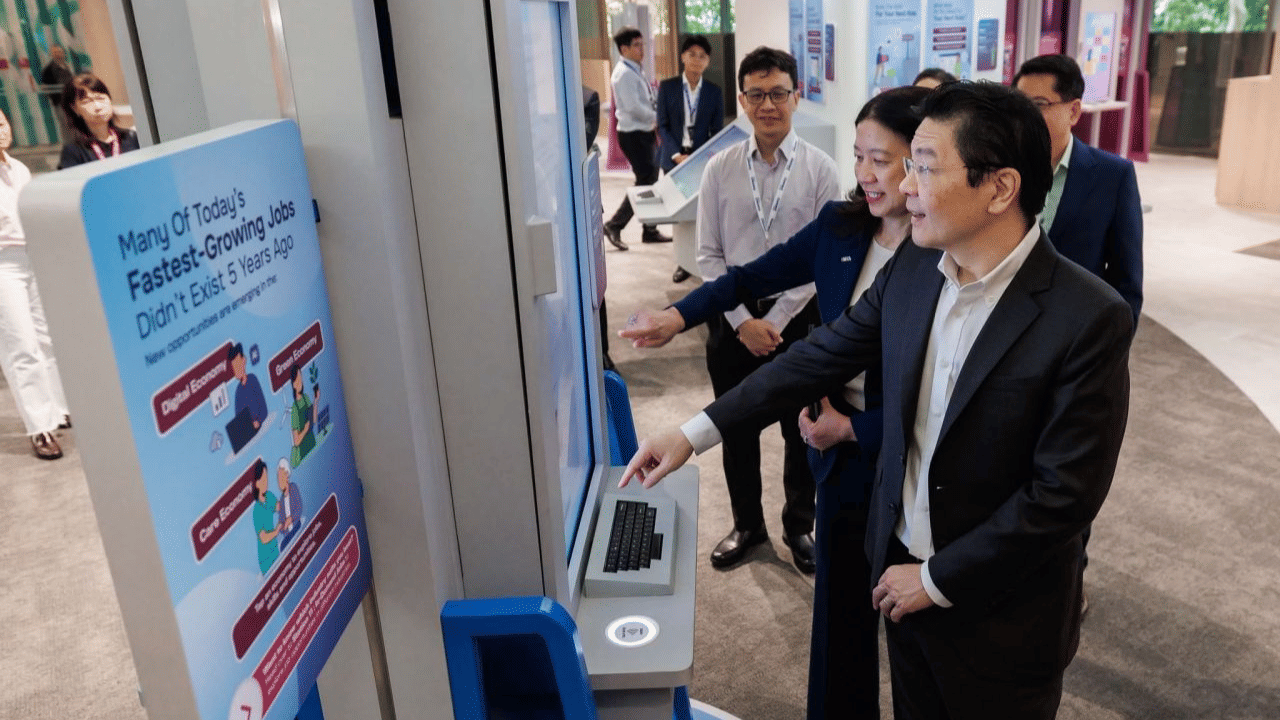
The agency also launched Connect by SWDA, a new careers and skills service touchpoint at the Lifelong Learning Institute, in presence of Prime Minister and Finance Minister Lawrence Wong.
PM Wong has urged businesses to treat workforce planning as an integral part of business transformation, warning that decisions on people and skills cannot be left to HR after operational changes have already been made.
He also outlined three key shifts Singapore needs to make in its approach to skills and workforce development: linking learning more closely to jobs and careers; ensuring businesses and workers transform together; and making employment and skills support easier to navigate.
As technology reshapes jobs, workers may need to move into new roles or acquire new skills, Wong said. He stressed that Singapore’s skills system must provide support through these transitions, while businesses also take responsibility for developing their employees.
More than 200 AI courses added
Alongside the portal, SWDA has rolled out a catalogue of more than 200 AI courses aimed at helping workers build practical AI capabilities.
The courses come with a complimentary six-month subscription to selected premium AI tools, giving participants opportunities to gain hands-on experience with AI applications in the workplace.
SWDA has also partnered with the Singapore Institute of Technology to develop the AI Ready Quiz, a self-assessment tool that measures users’ current AI proficiency and recommends relevant courses.
Employers can direct workers to the quiz through the OurWorkforce portal, which also hosts the AI course catalogue and tool subscription offering.
The agency said it will continue to identify emerging and in-demand skills, with AI among its priority areas, as businesses and workers respond to changes in the economy.
The measures build on Singapore’s broader push to develop an AI-capable workforce. Earlier in the year, Digital Development and Information Minister Josephine Teo announced the National AI Impact Programme to help 100,000 workers become “AI bilingual” over three years, combining expertise in their own fields with AI capabilities.
The programme also aims to support 10,000 local enterprises in integrating AI into their operations, alongside expanded grant support for SMEs adopting pre-approved AI tools.
Workforce support extends beyond skills
The latest announcements come as Singapore also expands its focus on workplace wellbeing and support for employees managing responsibilities inside and outside work.
At the launch, Minister of State for Manpower Foo Cexiang highlighted the pressures facing workers who balance employment with childcare, eldercare and other family responsibilities.
The centre is Singapore’s first integrated workplace wellness centre in the CBD, bringing services such as counselling, mindfulness programmes, family-oriented activities and physiotherapy closer to workers.
Foo cited MOM’s 2026 Report on Employees’ Working Conditions, which found that workers with access to employee support schemes reported significantly lower rates of burnout.
He said workplace wellbeing should not be viewed solely as an individual responsibility, pointing to the role employers and community organisations can play in supporting workers.
The development reflects a broader shift in Singapore’s workforce strategy, from focusing solely on skills and employability to combining workforce transformation with support for workers’ wellbeing and resilience.