










Malaysia's unemployment rate climbed to 3.0% in April, reaching its highest level in six months as the number of people entering the labour market grew faster than the pace of job creation, raising fresh questions about the strength of employment growth amid rising layoff concerns.
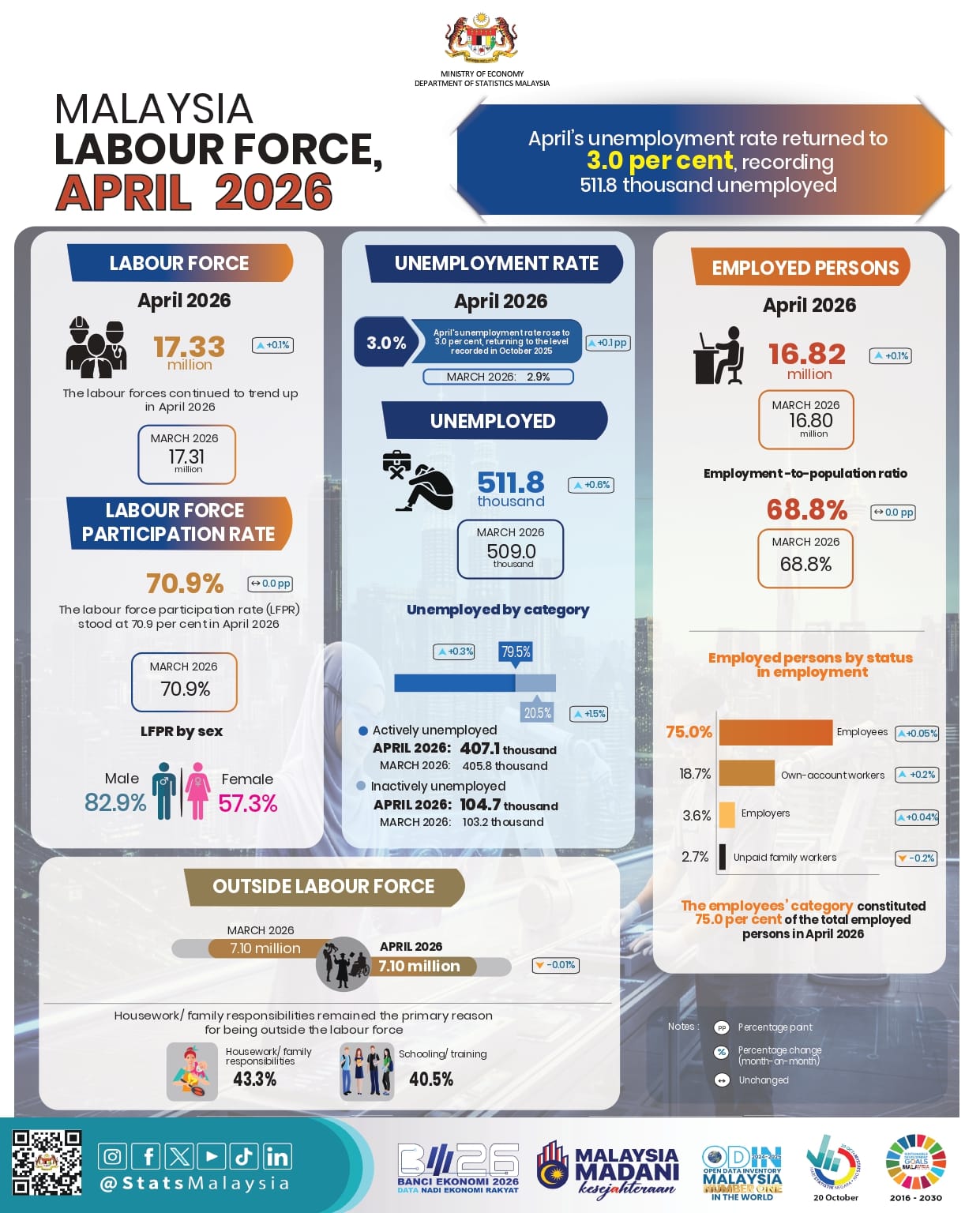
Latest data from the Department of Statistics Malaysia (DOSM) showed the number of unemployed persons increased by 0.6% month-on-month, or 2,900 people, to 511,800 in April, up from 509,000 in March. The rise pushed the unemployment rate to 3.0%, ending five consecutive months of stability at 2.9% and returning it to the level last seen in October 2025.
The increase comes as policymakers closely monitor labour market conditions following a recent uptick in retrenchments. Economy Minister Datuk Seri Akmal Nasrullah Mohd Nasir said this week that the government will release updated layoff figures for May after reports showed that 7,057 workers lost their jobs in April, a 21% increase from 5,855 in March.
Jobs continue to grow, but at a slower pace
Despite the rise in unemployment, Malaysia continued to create jobs during the month, highlighting the resilience of the labour market even as signs of moderation emerge.
The number of employed persons rose by 0.1%, or 11,800 people, to 16.82 million in April from 16.80 million in March.
However, the labour force expanded at a faster pace, increasing by 14,600 people to 17.33 million, resulting in a larger pool of job seekers than available new jobs.
The employment-to-population ratio, a key measure of an economy's capacity to generate jobs, remained unchanged at 68.8%, indicating that employment growth broadly kept pace with population trends.
Malaysia's labour force participation rate (LFPR) also remained at a record-high 70.9% for the fourth consecutive month, reflecting sustained confidence among Malaysians in seeking employment or remaining economically active.
"The increase in unemployment should be viewed within the context of a growing labour force rather than a contraction in hiring activity," economists noted, pointing to continued gains in overall employment despite the uptick in joblessness.
Services sector remains the engine of job creation
The services sector continued to drive employment growth, with the largest gains recorded in wholesale and retail trade, accommodation and food and beverage services, and information and communication activities.
Employment also expanded across manufacturing, construction, agriculture, and mining and quarrying sectors, suggesting that hiring remained broad-based despite an increasingly uncertain global environment.
Employees continued to account for the majority of Malaysia's workforce, representing 75% of total employment. The number of employees rose marginally by 6,300 to 12.61 million persons in April.
Meanwhile, the number of own-account workers, individuals operating their own businesses or working independently without paid employees, increased by 6,200 to 3.15 million, although the pace of growth was the slowest in three months.
Also Read: Malaysia clarifies employment pass salary revisions ahead of June rollout
Youth unemployment remains elevated
While overall labour market conditions remained stable, youth unemployment continued to pose a challenge.
Among Malaysians aged between 15 and 24 years, the unemployment rate remained unchanged at 10.2%, affecting approximately 290,800 young people. The figure remains more than three times the national unemployment rate, underscoring the difficulties many first-time job seekers face when entering the workforce.
At the same time, the number of people outside the labour force edged down marginally to 7.10 million, extending a gradual downward trend. Household and family responsibilities remained the primary reason for labour force inactivity, accounting for 43.3% of those outside the workforce, followed by education and training commitments at 40.5%.
Rising layoffs and fewer vacancies signal caution
While economists continue to describe Malaysia's labour market as fundamentally resilient, several forward-looking indicators suggest hiring momentum may be softening.
Kenanga Research noted that reported loss-of-employment (LOE) cases rose to 7,766 in May from 7,162 in April, significantly above the 2025 monthly average of 6,237 cases. Preliminary figures also showed that 1,531 job losses had already been recorded during the first five days of June.
At the same time, active job vacancies fell to 107,439 at the end of May from 112,429 a month earlier, potentially pointing to weaker hiring demand in the months ahead.
The research house warned that downside risks could intensify in the second half of the year if external economic headwinds begin to affect export-oriented industries.
Outlook remains positive despite external risks
DOSM maintained that Malaysia's labour market outlook remains favourable in the near term, supported by resilient domestic demand, sustained investment activity, tourism-related hiring, and ongoing economic development initiatives.
Government efforts to create alternative employment opportunities, expand skills training in high-growth sectors such as artificial intelligence and information technology, and strengthen the country's semiconductor ecosystem are also expected to support employment growth.
Kenanga Research maintained its 2026 unemployment forecast at 2.9% and its GDP growth projection at 4.5%, while expecting second-quarter economic growth to remain above 5%.
However, economists cautioned that geopolitical tensions, elevated energy prices, and weaker global demand could weigh on business activity and hiring decisions later in the year.
For now, the latest figures suggest Malaysia's labour market remains on solid footing. Yet with layoffs rising, vacancies declining, and unemployment ticking higher, policymakers and businesses alike will be watching closely to determine whether April's increase marks a temporary adjustment or the beginning of a broader slowdown in labour market momentum.