








AI & Emerging Tech
Organisations should start with the process before deploying AI, says Meralco CHRO at TechHR Pulse Philippines’26






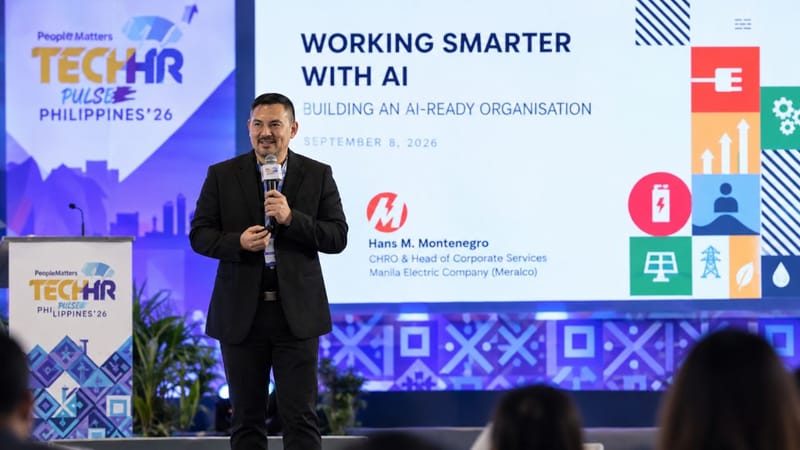
TechHR Pulse Philippines’26: Meralco CHRO Hans Montenegro on putting processes, people and business value ahead of technology in AI transformation.
AI transformation is not simply a technology exercise. For organisations looking to embed AI into everyday work, the bigger challenge is deciding where it can create real value, how roles will change and whether employees are equipped for what comes next.
At TechHR Pulse Philippines’26, Hans Montenegro, CHRO and Head of Corporate Services at Meralco, shared a practical approach to this challenge. His message was clear: organisations should begin with the process they want to improve, assess the people doing the work, and only then determine where AI can make a difference.
“Technology doesn’t lead the discussion,” Montenegro said. “You start with the process. What are we trying to fix?”
The approach moves AI away from a narrow focus on automation and job reduction, and towards three broader outcomes: creating capacity, generating revenue and building new workforce capabilities.
The process-first approach
Montenegro’s approach to AI transformation follows a simple sequence:
Start with the process: Identify the problem the organisation is trying to solve.
Define what good looks like: Work backwards from the desired outcome to identify what needs to change.
Assess the workforce: Determine whether existing employees can perform the redesigned process.
Build new capabilities: Upskill or reskill employees where the new process requires different skills.
Choose the technology: Only after these steps should organisations decide where AI can create value.
“Technology does not lead the discussion,” he noted. “You start with the process. What are we trying to fix?”
The approach, he said, was shaped partly by seeing technology deployments fail when organisations moved to digitise without first understanding the process or engaging the people affected by the change.
“If we improve the process, are the people currently doing the process capable of performing the new process?” he further added. “And if the answer is no, how do we upskill them?”
From job cuts to job creation
For Montenegro, one of the biggest challenges in AI adoption is the perception that automation is primarily about eliminating jobs.
“AI keeps getting treated like some boogeyman that will take your job,” he said. “But the companies that have succeeded have actually used AI as a job creator, as a revenue generator and also as a force multiplier.”
He pointed to ATMs as an example of how technology can automate tasks without eliminating the need for people. As cash handling became automated, bank employees could take on other responsibilities, while banks could expand their operations.
This thinking is reflected in the business cases Meralco has developed around AI. Rather than starting with a target for headcount reduction, Montenegro said he looks for opportunities to increase revenue, reduce costs or improve capability.
A revenue opportunity in customer applications
One of Meralco’s first use cases was its service application process for new electricity connections.
Montenegro selected the process because it was revenue-generating, customer-facing and offered opportunities to streamline documentation and reduce errors.
By simplifying and automating parts of the process, an employee who previously handled a certain number of applications could process significantly more.
“The same person who could process X number of applications a week could suddenly now process 3X applications a week,” he said. “Because it is simpler, it is quicker, it is automated.”
The objective was therefore not to remove employees from the process but to increase what the existing workforce could accomplish.
PHP60 million in potential hiring costs
Meralco’s move towards automated electricity meters provided another use case.
The company is upgrading meters for its 8.3 million customers, according to Montenegro. The transition involves a significant amount of data migration. Initially, the company estimated it would need to hire around 800 to 900 contractual workers to support the work.
Instead, Meralco explored how technology could be embedded into the largely manual process.
Montenegro said the approach could save the company about PHP60 million in contractual hiring costs.
But the workforce impact went beyond avoiding additional hiring.
The company also had to consider its existing manual meter readers, many of whom had accumulated years of experience working with energy data.
“I have a workforce that has 10 to 15 years of experience in reading energy data,” Montenegro said. “I am going to teach you to be energy data analysts. I am going to teach you how to track patterns in consumption and track patterns in utilisation.”
The shift turns existing operational knowledge into a potential new capability rather than allowing automation to make that knowledge redundant.
Reskilling becomes part of the AI strategy
For Montenegro, employees need to be part of the transition from the beginning.
Meralco engaged its meter readers and union representatives as the company considered how their work would change. The message was that employees would need to learn new skills as manual tasks were automated.
“The question is, are you willing to learn?” he said.
The same principle applied to the service application process, where employees doing the work helped co-author the redesigned process.
“It wasn't ‘I am going to automate your job so that you are gone’. That is not the message,” Montenegro said. “You are doing this day in and day out. How can I make your job easier?”
For HR, this means being involved before technology is deployed, rather than managing the workforce impact afterwards.
Start small and prove the value
Montenegro also cautioned organisations against attempting to deploy AI across the entire enterprise at once.
“Stop trying to boil the ocean with your deployments,” he said. “Start small, generate a proof of concept, and then wash, rinse, repeat.”
Meralco currently has two AI projects underway, with around eight more in the backlog, according to Montenegro.
The initial projects have also helped generate demand from other parts of the organisation. Finance has approached the team about possible applications for general ledger processes, while legal has explored using AI for archiving jurisprudence.
“Instead of trying to demonstrate a proof of concept so that I can go and ask everyone else, the reverse is happening now,” Montenegro said. “They're coming to me now.”
The approach has therefore created an internal pull for AI rather than requiring the company to push adoption across every function simultaneously.
The harder part is changing how people work
For Montenegro, buying technology is the easy part. The bigger challenge is helping employees understand how their work is changing and preparing them to operate differently.
“The easiest thing to do is to buy the technology,” he said. “The harder thing to do is to allow people to understand that work is changing. They are part of the change.”
That puts HR at the centre of the transformation, not because HR needs to build the AI, but because it needs to help the organisation redesign work around it.
The Meralco case suggests a simple sequence: understand the process, identify what needs to improve, involve the people doing the work, build the required capabilities and then apply technology where it can create value.
Author
Loading...