








Economy Policy
Singapore Budget 2026 & the AI nation agenda: PM Wong details AI push and workforce plans






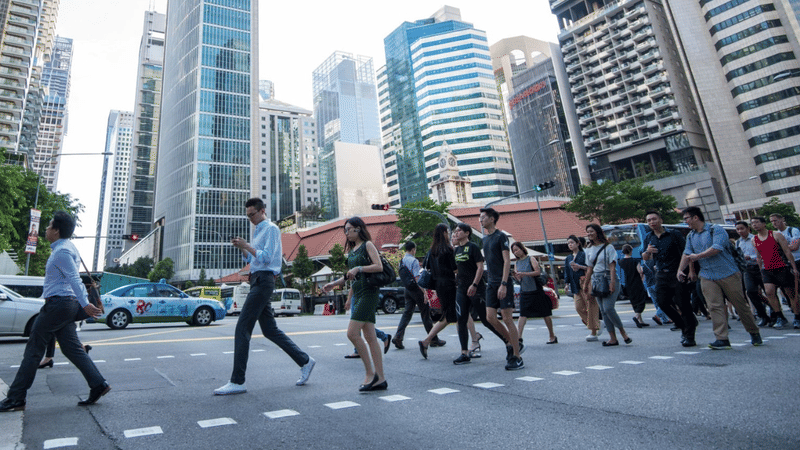
Singaporeans who enrol in selected AI courses will receive six months of free access to premium AI tools. “This will allow them to practise, experiment, and apply what they have learnt,” PM Wong said.
Singapore will step up its national artificial intelligence strategy with new governance structures, targeted industry missions and expanded workforce support, Prime Minister Lawrence Wong announced in Budget 2026 on Thursday (Feb 12).
Framing AI as both an economic opportunity and a societal challenge, Wong said Singapore would not retreat in the face of rapid technological change.
“Fear cannot be Singapore’s response to artificial intelligence,” PM Wong said. “If we allow uncertainty to paralyse us, we will fall behind in a world that is moving rapidly ahead.”
National AI Council to steer strategy
A new National AI Council will be established and chaired by Wong to provide strategic direction and coordinate Singapore’s AI agenda across ministries.
“We will therefore establish a new national AI Council, which I will chair to provide strategic direction and to drive Singapore's AI agenda for AI to truly transform our economy,” he said.
The council will oversee a new set of national AI “missions” aimed at driving transformation in four priority sectors: advanced manufacturing, connectivity and logistics, finance, and healthcare.
“These missions will drive AI-led transformation in key sectors of our economy, and push the boundaries of what is possible for Singapore and for the world,” Wong said, adding that the initiatives will come with “clear objectives and tangible outcomes”.
Within government, research and development, regulatory frameworks and investment promotion efforts will be better aligned, alongside regulatory sandboxes that allow companies to test AI innovations safely and responsibly.
Targeted support for businesses
To accelerate enterprise adoption, the Government will launch a new Champions of AI programme for firms seeking comprehensive AI transformation. Support will be tailored to each company and include business transformation and workforce training.
“As these companies succeed, they will set benchmarks for their industries and inspire others to follow,” Wong said.
Tax incentives will also be expanded. The Enterprise Innovation Scheme will include AI-related expenditures as a qualifying activity for the Years of Assessment 2027 and 2028, capped at S$50,000 per year. The scheme currently offers 400 per cent tax deductions for qualifying innovation activities.
The Productivity Solutions Grant will be broadened to support a wider range of digital and AI-enabled tools, particularly for small and medium-sized enterprises.
Singapore will also develop a larger AI park at one-north, building on the existing Lorong AI pilot hub. “This will be a new cluster to catalyse ideas, forge collaborations, and translate AI initiatives into practical solutions for businesses and public services,” Wong said.
Managing disruption, not avoiding it
Alongside industry transformation, Wong acknowledged deep anxieties about job displacement, misinformation and the ethical use of powerful technologies.
“Workers worry that AI will displace jobs. Societies worry about misinformation, bias and the ethical use of powerful technologies,” he said. “These anxieties are real – and we must confront them squarely.”
He stressed that Singapore would press ahead with AI adoption while ensuring workers are supported.
“We will help workers use AI to take over routine tasks so they can focus their time and energy on higher value activities, work that requires judgement, creativity and human insight, that cannot be replaced by machines,” he said.
Where roles are affected, transitions will be managed carefully with unions to help workers move into new opportunities.
“Our commitment is, every Singaporean who is willing to adapt and learn will continue to secure a good job and earn a good living,” he added.
Expanding AI skills and access
To raise AI fluency across the workforce, the Government will expand the TechSkills Accelerator (TeSA) to support AI training in non-technology and cross-sectoral roles.
The Infocomm Media Development Authority will work with professional bodies to identify new competencies required to redesign workflows around AI, starting with sectors such as accountancy and law.
For students, AI literacy will be strengthened across Institutes of Higher Learning. “For the next generation, we will strengthen AI literacy for students across all our institutions of higher learning,” Wong said, emphasising strong foundations and critical thinking so that AI is used wisely rather than as a shortcut.
The SkillsFuture website will be redesigned to make AI learning pathways clearer and easier to navigate.
Singaporeans who enrol in selected AI courses will receive six months of free access to premium AI tools. “This will allow them to practise, experiment, and apply what they have learnt,” he said.
A trusted AI hub
Wong said Singapore’s competitive edge does not lie in building the largest frontier AI models, but in deploying AI effectively, responsibly and at speed.
“Singapore can be a trusted hub where companies and researchers come together to develop, test and deploy impactful AI solutions, and do so faster and more coherently than many larger countries,” he said.
“Singapore will not be passive in the face of rapid changes around us. We will adapt. We will compete. We will continue to move forward with confidence.”
Author
Loading...