








Economy Policy
‘40% corporate income tax rebate’: PM Wong delivers Singapore Budget 2026 amid global uncertainty






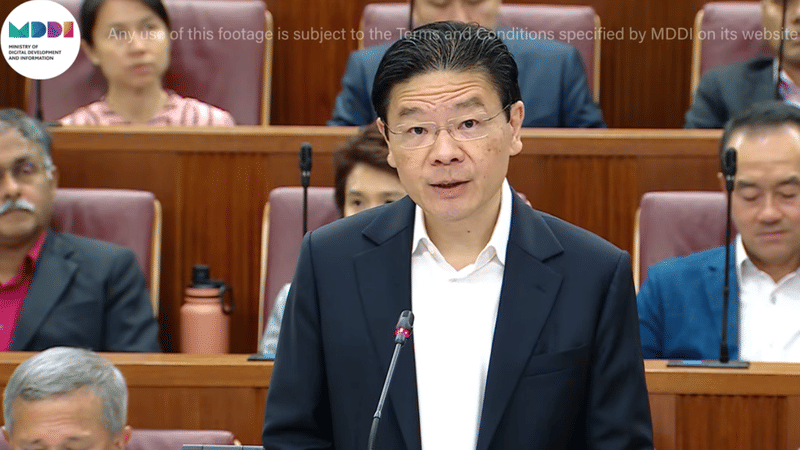
“Our ambition is to secure growth at the higher end of the 2 to 3 per cent range over the next decade,” PM Wong said, signalling a continued focus on productivity and structural transformation.
Prime Minister and Finance Minister Lawrence Wong is delivering Singapore’s Budget 2026 in Parliament on Thursday (Feb 12), setting out measures to steady businesses and position the economy for a more uncertain global environment.
Opening his speech with a stark assessment of the shifting global order, Wong said “an era has ended”, as trade rules that were once championed are increasingly being set aside.
“Guardrails are eroding, and longstanding norms are becoming less reliable,” he told the House, underscoring the challenges facing open economies like Singapore.
40% corporate income tax rebate for 2026
As part of the measures announced so far, businesses will receive a "40 per cent corporate income tax rebate" for the Year of Assessment (YA) 2026 to help them stay competitive.
Every active company that employed at least one local employee in 2025 will receive a minimum benefit of S$1,500, Wong said during his speech.
To qualify, firms must have made Central Provident Fund (CPF) contributions to at least one Singapore citizen or permanent resident employee.
Shareholders who are also directors of the company in the 2025 calendar year will not count towards this requirement.
The total benefit for each company, comprising the corporate income tax rebate and a corporate income tax rebate cash grant, will be capped at S$30,000. Eligible companies will automatically receive the benefits from the second quarter of 2026 onwards.
Although the Singapore economy performed well last year, Wong noted that some businesses continue to face cost pressures and operating challenges. “This will provide short-term relief, as we press on with our restructuring and transformation efforts,” he said.
In last year’s Budget, the government had announced a 50 per cent corporate tax rebate for YA2025, with a minimum benefit of S$2,000 and a cap of S$40,000.
Growth expected to moderate
Wong said some of the positive economic momentum is expected to continue this year. However, amid heightened global uncertainties, the outlook is likely to moderate.
Singapore’s growth for 2026 is projected at 2 to 4 per cent, with inflation forecast at 1 to 2 per cent.
“Our ambition is to secure growth at the higher end of the 2 to 3 per cent range over the next decade,” he added, signalling a continued focus on productivity and structural transformation.
Expanded support for internationalisation and financing
Beyond tax rebates, Wong announced enhancements to schemes aimed at helping businesses expand overseas and strengthen resilience.
Support levels for grant schemes that help companies internationalise will be increased to up to 70 per cent for small and medium enterprises (SMEs), and up to 50 per cent for non-SMEs.
The Market Readiness Assistance grant will be enhanced to support companies not only in accessing new markets, but also in deepening activities in existing overseas markets.
Under the Double Tax Deduction for Internationalisation (DTDi) scheme, companies currently enjoy a 200 per cent tax deduction on selected qualifying activities, capped at S$150,000. Wong said more qualifying activities will be eligible for automatic claims, and the cap will be raised to S$400,000.
The Enterprise Financing Scheme will also be enhanced by increasing the maximum loan quantum for trade and fixed asset loans. Additional support will be provided for companies pursuing significant overseas ventures that require higher capital outlay.
Forging closer regional ties
As part of efforts to safeguard trade flows, Wong said Singapore will sign a first-of-its-kind agreement with New Zealand later this year on trade in essential supplies, to ensure continuity of critical flows during times of crisis.
Singapore will also step up engagement with fast-growing markets in Latin America, Africa and the Middle East, establishing new embassies and strengthening its diplomatic and economic presence to capture emerging opportunities.
Regionally, the government is working with neighbouring countries to deepen integration, including cooperation on the Johor-Singapore Special Economic Zone and the Batam-Bintan-Karimun free trade zones in Indonesia.
As global uncertainty rises, Wong framed Budget 2026 as both a stabilising measure and a strategic push for transformation. “We must adapt to this new environment,” he said, signalling that resilience, diversification and deeper partnerships will anchor Singapore’s economic strategy in the years ahead.
More measures are expected as PM Wong continues to outline the government’s plans to navigate what he describes as a more fragmented and unpredictable global landscape.
Author
Loading...