








Leadership
HR’s future rests on adoption, not hype: Pushkaraj Bidwai at TechHR Pulse



 ||
||

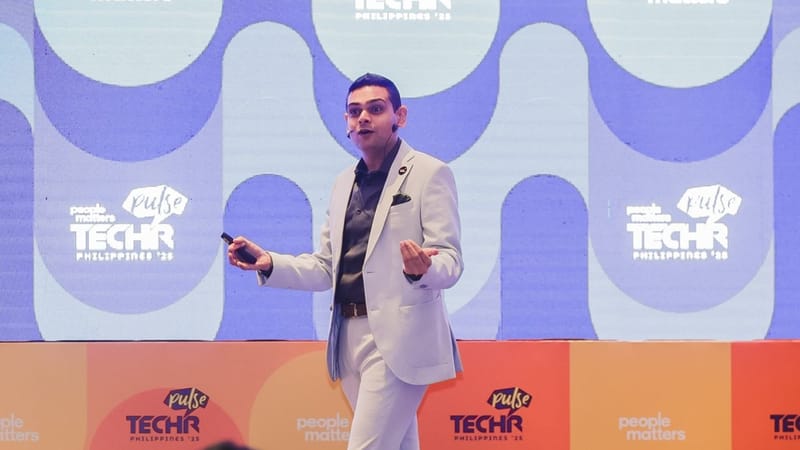
At TechHR Pulse Philippines 2025, CEO Pushkaraj Bidwai urged Asia’s HR leaders to break boundaries, embrace AI adoption and project a global voice.
The ballroom at the Marriott Manila stirred with a restless energy. Leaders of talent and business had come from across Southeast Asia to the People Matters TechHR Pulse Philippines 2025 conference — a day billed not as another gathering of HR professionals, but as a chance to reimagine the very boundaries of work.
On stage, Pushkaraj Bidwai, chief executive officer of People Matters, struck a tone that was equal parts provocation and invitation. His words landed with clarity amid the swirl of conversations on digital change and the future of work.
“Tech implementation does not mean anything,” he told the assembled delegates. “It’s the adoption. The currency of adoption is what we need to trade in.”
It was more than a line for the room. It was a distillation of the challenge facing HR across Asia: organisations have installed systems, rolled out platforms and written strategies. Yet the test lies not in implementation, but in whether people and leaders are ready to use, absorb and transform with them.
Asia’s voice, Asia’s moment
Bidwai’s keynote was not only about technology. It was also about geography — and identity.
For too long, he argued, Asian organisations have imported models of HR from economies far removed from their own realities. “Our talent challenges are unique. Our people are unique,” he said. “We are very proud that we are building something from Asia to the world.”
The words carried the weight of People Matters’ own journey. From early beginnings in India and Singapore, the organisation has expanded into Indonesia, the Philippines, Australia and the Middle East. Today it connects around 500,000 HR and talent leaders daily through content, research and events.
That reach, Bidwai suggested, must be more than an audience. It must be a voice. A region that is digitising at supersonic speed, juggling demographic transitions, and fuelling global growth cannot rely on templates created elsewhere. It must build and export its own.
Breaking boundaries
The theme of the Manila event — Breaking Boundaries — was no empty slogan. Bidwai framed it around three calls.
First, break from the past. Incremental changes, however comfortable, cannot answer to disruption. Legacy policies and outdated systems are poor shields against markets in flux.
Second, break from the noise. Artificial intelligence, he said, has flooded the corporate imagination with headlines and hype. But HR leaders must look past the chatter and focus on genuine use cases that shift outcomes.
Third, break open to possibility. The future is not linear. Uncertainty is not a threat to be managed but an invitation to reimagine.
To make the point visceral, delegates were asked to share personal stories of breakthroughs with people they had never met before. Coloured threads stretched across tables as conversations unfolded, binding the hall in a visible network. The metaphor was deliberate: transformation comes not from staying within lines, but from weaving connections that dissolve them.
Data with a warning
The keynote also marked the Southeast Asian launch of People Matters’ SHARPA 2025: State of HR Industry Report, released for the first time in the region. Positioned as a guide for HR leaders to “scale new heights,” the report examines how rapid digitalisation, shifting skill demands, uneven AI adoption and heightened productivity pressures are colliding with macroeconomic uncertainty and changing consumer patterns.
Its message was clear: success in 2025 will depend on how quickly HR can turn these external shocks into a competitive advantage.
Covering 1,200 organisations, six million employees and $1.7 trillion in value, the study revealed progress, contradictions and gaps. Technology maturity has risen 21 per cent in three years, signalling stronger investment. Seventy-eight per cent of HR leaders now describe themselves as “change-ready.”
Yet when asked about execution, the confidence falters. Preparedness scores for succession planning, middle-management development and upskilling fell as low as 20 to 24 per cent — exposing a paradox of optimism in rhetoric but caution in reality.
Artificial intelligence displayed the same divide. Only 17 per cent of organisations reported full adoption of AI in HR processes. Limited expertise, weak integration and poor prioritisation were the chief barriers.
“It’s almost like the darkness beneath the lamp,” Bidwai observed. “When it comes to our own upskilling, prioritisation comes last. That needs to change, because it’s not just hurting us. It’s hurting the business.”
The research distilled three urgent gaps.
- AI readiness. Pilots abound, but expertise and integration are thin.
- Value realisation. Organisations measure success by installation, not usage. Adoption — the real currency — remains undervalued.
- Effectiveness. Strategies exist on paper, but execution falters, particularly in succession planning and leadership pipelines.
The consequences are sobering. Nearly 60 per cent of HR transformation projects this year are expected to fall short unless these gaps are closed.
The CHRO as AI champion
One of Bidwai’s most pointed arguments challenged assumptions about ownership. For many organisations, artificial intelligence belongs to the CIO or CTO. Bidwai offered another possibility: the CHRO.
He drew a parallel with the history of social media. In its early days, social strategy sat with technology teams. Over time, marketing leaders claimed it, making it core to their discipline. The same, he suggested, could happen with AI.
“Maybe the CHRO is a very good contender for championing the AI change in the organisation,” he said. HR platforms, after all, touch every employee, from onboarding to performance reviews. Adoption at scale, he argued, is as much a people challenge as it is a technical one.
He was careful to frame HR not as an island but as a lever of business strategy. Capital flows are volatile. Consumer spending in Asia is rising, but labour markets are shifting. These pressures make talent and culture central to resilience.
Business growth, he said, is inseparable from talent strategy. It is not enough for plans to be local or incremental. They must be orchestrated at scale, connected to skills clusters and aligned with AI readiness. “If business growth is to be sustained,” he warned, “then adoption must become the central measure of success.”
Three imperatives
The keynote concluded with a triad of imperatives.
-
Make leadership, talent and AI the centre of HR strategy.
-
Ensure data flows freely. Best-of-breed technology choices will fail without fluid, integrated data.
-
Judge success by adoption, not deployment. Implementation without uptake is wasted capital.
These priorities, Bidwai stressed, cannot remain confined to HR departments. They must be elevated to boardrooms and C-suites as business imperatives.
Beyond the contours
As he closed, Bidwai returned to the metaphor that framed the day.
“The world does not wait for defined contours,” he told the audience. “Leaders who have succeeded have always gone beyond them. Can you go beyond the defined contours? That is where success would be unlocked.”
The words captured both a warning and a hope: that Asia’s HR leaders must not only prepare their organisations for disruption, but also shape the global discourse on how disruption is met.
For those gathered in Manila, it was a call to step forward — not as spectators of transformation, but as its authors.
Author
Loading...