








Economy Policy
Singapore, Vietnam to deepen ‘pi-shaped’ leadership exchanges, technology cooperation






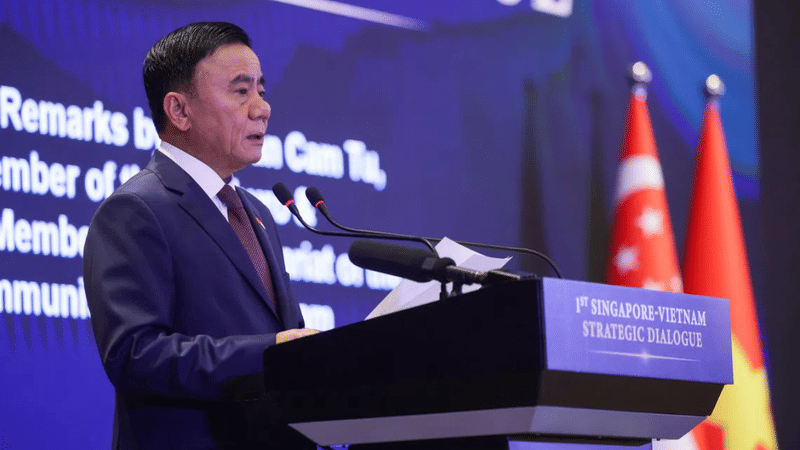
Coordinating Minister for Public Services Chan described pi-shaped leaders, as leaders with deep expertise in one or two areas who can also work across organisational boundaries and connect different perspectives.
Singapore and Vietnam have agreed to deepen exchanges and training between government officials while expanding cooperation in technology, as the two countries seek to strengthen their partnership amid rapid technological and economic change.
The agreements were formalised on August 25 on the sidelines of the inaugural Singapore-Vietnam Strategic Dialogue, where the two sides exchanged an agreement on study visits for senior Vietnamese officials and released a joint statement on their technology connectivity strategy.
The new high-level dialogue is intended to provide a platform for both countries to exchange views on emerging challenges and identify areas for closer cooperation. It follows the elevation of Singapore-Vietnam relations to a Comprehensive Strategic Partnership in 2025. Singapore's Ministry of Foreign Affairs said the strategic dialogue was among several initiatives agreed during Vietnamese President To Lam's state visit in May 2026.
Coordinating Minister for Public Services Chan Chun Sing, who co-chairs the dialogue with Vietnamese counterpart Tran Cam Tu, said the platform builds on decades of bilateral ties and mutual trust.
“Many of the opportunities we discuss today will take time to materialise,” Chan said, stressing that current and future generations of leaders would need to continue working together.
Singapore focuses on cross-sector leadership
Chan also outlined Singapore's approach to developing government leaders capable of navigating increasingly complex policy challenges.
He said governments are operating in an environment where economic, technology and national security issues are becoming increasingly interconnected, while artificial intelligence and other emerging technologies are creating both opportunities and new risks.
Singapore therefore sees leadership development as a strategic national capability, with an emphasis on building leaders who possess both depth in specific areas and the breadth to understand issues across sectors.
Chan described this as developing “pi-shaped” leaders, officials with deep expertise in one or two areas who can also work across organisational boundaries and connect different perspectives.
He said this is increasingly important because many challenges facing governments do not fall neatly within the responsibility of a single ministry.
“The expectation is not for every leader to possess the same depth in every area,” Chan said, adding that leadership teams need to collectively have sufficient expertise while being able to integrate different perspectives in the broader national interest.
Vietnam, meanwhile, said it is interested in learning from Singapore's experience in public administration, national governance and leadership development.
Tu said Vietnam is seeking to build a pipeline of potential leaders and managers, particularly among officials already identified for leadership roles and promising young graduates, to support the country's medium- and long-term development.
Technology cooperation moves towards commercialisation
Technology cooperation was another key focus of the dialogue, with both sides highlighting the need to move beyond technology transfers and investment towards joint research, development and commercialisation.
Tu called for the government, scientific community and businesses to work together to develop innovative products and technology ecosystems that can support both countries' development and contribute to the wider region.
“The goal is not just to attract investment or technology transfers, but to jointly research, develop, and master technology and build innovative products and ecosystems in support of both countries’ development and contribute to the region,” Tu said.
Chan said countries would need greater interoperability and common approaches to unlock the potential of AI, facilitate cross-border data flows and integrate digital economies.
He also stressed that political and business leaders do not necessarily need to be technologists, but must have enough understanding of technology to identify opportunities, assess risks and make informed decisions about its deployment.
The focus on digital and technology cooperation builds on a broader expansion of bilateral economic and innovation ties.
For employers and HR leaders, the growing emphasis on leadership capability, technology adoption and cross-border cooperation also points to the importance of building workforces that can operate across disciplines as AI and digital technologies reshape jobs and organisational structures.
Topics
Author

Loading...