








Life At Work
Thailand job market under pressure as 19,000 workers face temporary suspensions






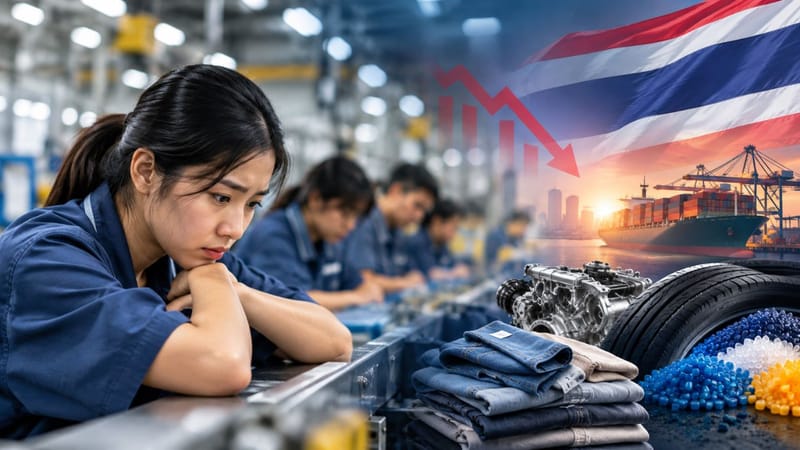
Automotive, garment, rubber and plastics businesses cut operations as orders fall and costs rise.
Thailand’s labour market is coming under pressure as businesses in the automotive parts, garment, rubber and plastics industries temporarily suspend operations, according to media reports.
Falling orders, mounting losses and rising production costs are forcing more businesses to reduce work, putting thousands of jobs at risk.
Temporary suspensions affected 18,998 workers in June 2026, up 58.08% from May and 18.61% from a year earlier, according to figures cited by the Federation of Thai Industries (FTI).
More workers affected by partial shutdowns
In June, 44 establishments partially suspended operations, up 22.22% from May. Another 23 stopped operations completely, down 14.81%.
Despite the fall in full shutdowns, the number of workers affected rose sharply.
Pimjai Leeissaranukul, chairwoman of the FTI, said employment remained broadly stable in July but warned that manufacturing was showing signs of deeper structural weakness.
The Bank of Thailand has also raised concerns about businesses using Section 75 of the Labour Protection Act to temporarily suspend work amid intense competition and weak demand.
Four industries face different challenges
sAutomotive parts
The shift from internal combustion engine vehicles to electric vehicles is reducing demand for some traditional automotive components.
The FTI estimates that an internal combustion engine vehicle has around 30,000 parts, compared with 1,500 to 3,000 parts in an EV.
The change is beginning to affect employment across Thailand’s automotive parts industry.
Garments
Thai garment makers are facing stronger competition from imports and lower-cost overseas producers.
Ready-made clothing imports rose 12.30% year on year in the first half of 2026, while the garment Manufacturing Production Index fell 2.18%.
Capacity utilisation was just 49.06%, with manufacturers also facing higher production costs and pressure to improve technology, product development and branding.
Rubber products
Rubber manufacturers are dealing with volatile oil prices, higher input costs and supply disruptions linked to the conflict in the Middle East.
Factories are delaying orders while they assess market conditions. Higher energy, chemical and transport costs are also squeezing margins.
Plastics
The plastics industry is particularly exposed to supply disruptions in the Middle East, which provides 60% to 70% of Thailand’s naphtha imports, a key raw material for plastics.
Shipping disruptions have tightened resin supplies, forcing domestic producers to cut output by 25% to 30%.
Production costs also rose by 30% to 50% between March and May 2026. Some SMEs have been unable to absorb the higher costs and have closed.
Section 75 gives businesses temporary relief
Some struggling businesses are using Section 75 to reduce operations while they try to recover.
Saengchai Teerakulvanich, chief strategy officer of the Federation of Thai SMEs, said businesses were facing prolonged liquidity problems, operational challenges and volatile markets.
Under Section 75, employers can temporarily suspend work when circumstances prevent normal operations. Employees must receive at least 75% of their normal working-day wages during the suspension.
Employers must also give employees and labour inspectors at least three working days’ written notice.
However, Saengchai warned that temporary suspensions could become permanent closures without further support.
“If there are no support measures, many businesses using Section 75 will ultimately decide to close. That is the outcome we do not want to see,” he said.
Industry calls for support to protect jobs
Industry groups are calling for measures to help struggling businesses restart and retain workers.
Proposals include recovery plans, SME advisers and mentors, low-interest loans, factoring arrangements, debt restructuring and more flexible repayment schedules.
The growing use of temporary suspensions highlights the impact of economic and supply-chain pressures on job security, particularly in manufacturing.
For HR leaders, the challenge is not only keeping businesses running but also supporting employees through periods of reduced work, uncertainty and potential job losses.
Author
Loading...