








Recruitment
Malaysia to double expat pass salary requirements from June 1; extends work permits to 10 years







Malaysia will also extend expat work permit durations and allow all employment pass categories to bring dependants from June 1, ending the previous restriction on Category III holders.
Malaysia will significantly tighten its expatriate employment regime from June 1, 2026, doubling minimum salary thresholds for most employment pass (EP) categories as part of a broader effort to prioritise local talent while maintaining the country’s attractiveness as a business destination.
The changes, announced by the Malaysia Digital Economy Corporation (MDEC) and confirmed by the Ministry of Home Affairs, mark the first major revision to expatriate employment pass requirements since 2016. The revised salary thresholds will apply to all new and renewal EP applications submitted from June 1, 2026 onwards.
Under the new framework, the minimum base monthly salary for employment pass eligibility will rise from MYR 3,000 to MYR 5,000, effectively eliminating the current lowest salary band from qualifying for EP applications.
The revised salary thresholds are as follows:
EP Category I: MYR 20,000 and above
EP Category II: MYR 10,000 to MYR 19,999
EP Category III: MYR 5,000 to MYR 9,999
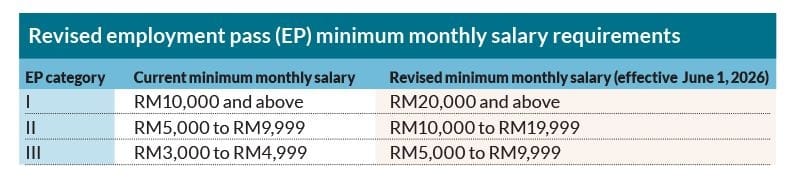
For expatriates in the manufacturing sector and manufacturing-related services, the Category III salary range will be set at MYR 7,000 to MYR 9,999.
MDEC said companies should plan ahead to avoid disruptions.
“All new and renewal employment pass applications submitted from June 1, 2026, onwards must comply with the revised minimum salary requirements,” it said, urging employers to align their foreign workforce strategies accordingly.
In parallel, Malaysia will also extend the maximum duration of expatriate work permits and relax dependant eligibility rules. From June 1, all EP categories will be allowed to bring dependants, a significant shift from current rules where Category III pass holders are generally excluded.
The highest-tier Category I pass will now be valid for up to 10 years, while Category II will also allow employment of up to 10 years, subject to succession planning requirements. Category III passes will be capped at a maximum of five years and will require structured succession plans involving local talent.
Previously, Category I passes were valid for up to five years, Category II for up to two years, and Category III for one year with limited renewals.
The Home Ministry said the reforms are aligned with the 13th Malaysia Plan and stem from engagement sessions with industry stakeholders held since 2022. The aim is to reduce reliance on foreign labour while ensuring expatriates with high-level expertise can continue contributing to the economy.
“The formulation of this new policy balances the need to prioritise qualified local talent with the importance of maintaining Malaysia’s competitiveness as a business-friendly investment destination,” the ministry said.
While further operational guidance from the Expatriate Services Division (ESD) is still awaited, businesses have been advised to review compensation structures and assess the potential impact on existing foreign employees, particularly those in Categories II and III who may face reclassification or renewal limits.
The Home Ministry said briefing and engagement sessions will be organised to ensure a smooth and transparent transition to the revised policy.
Author
Loading...
Loading...