








Wellbeing
Singapore workplace fatalities rise to 21 despite record-low major injury rate of 14.6







Ministry of Manpower is reviewing further measures to strengthen workplace safety ownership and accountability.
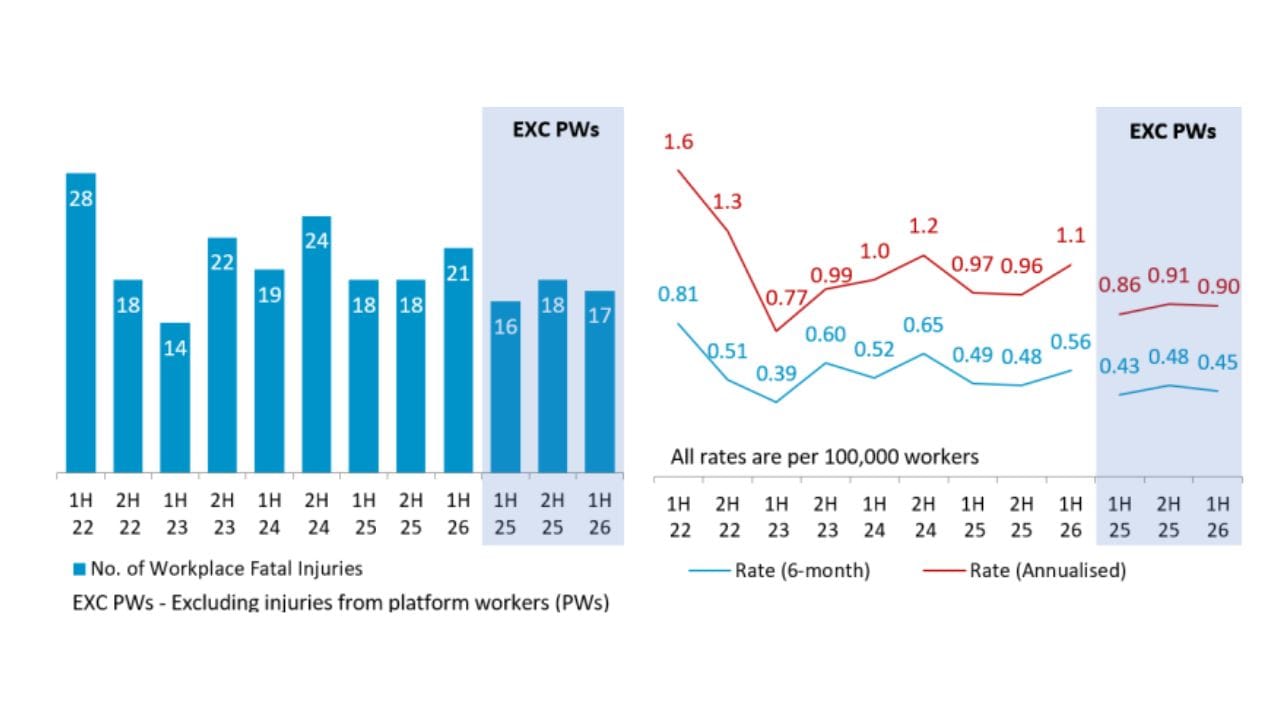
Singapore recorded 21 workplace fatalities in the first half of 2026, pushing the annualised fatal injury rate to 1.1 per 100,000 workers, up from 0.97 in the same period last year, according to the Ministry of Manpower's (MOM) latest Workplace Safety and Health Report.
At the same time, Singapore's annualised major injury rate excluding platform workers fell to a record low of 14.6 per 100,000 workers, from 15.8 in H1 2025. The rate is the lowest on record, excluding 2020 when workplace activity was disrupted by the COVID-19 pandemic.
Singapore workplace fatalities, 1H2022 to 1H2026
Number of workplace fatal injuries recorded in each half-year period.
Vehicular incidents drive fatalities
Vehicular incidents remained the leading cause of workplace deaths, accounting for nine fatalities in H1 2026. Seven were work-related traffic accidents, including four involving platform workers. Drowning and suffocation followed with five fatalities.
Overall, 90% of workplace fatalities, or 19 out of 21 cases, resulted from Type A incidents, which carry a higher risk of fatality.
MOM said the increase in fatalities, particularly those linked to vehicles, remains a concern. The government has already tightened penalties and introduced a nationwide two-week voluntary Safety Time-Out following a cluster of workplace deaths earlier in the year.
Major injuries fall to record low
Major workplace injuries declined to 274 cases excluding platform workers, down from 293 in H1 2025. The annualised major injury rate fell from 15.8 to 14.6 per 100,000 workers. Including platform workers, there were 314 major injuries, with an annualised rate of 16.7.
Annualised major injury rate excluding platform workers, by half-year.
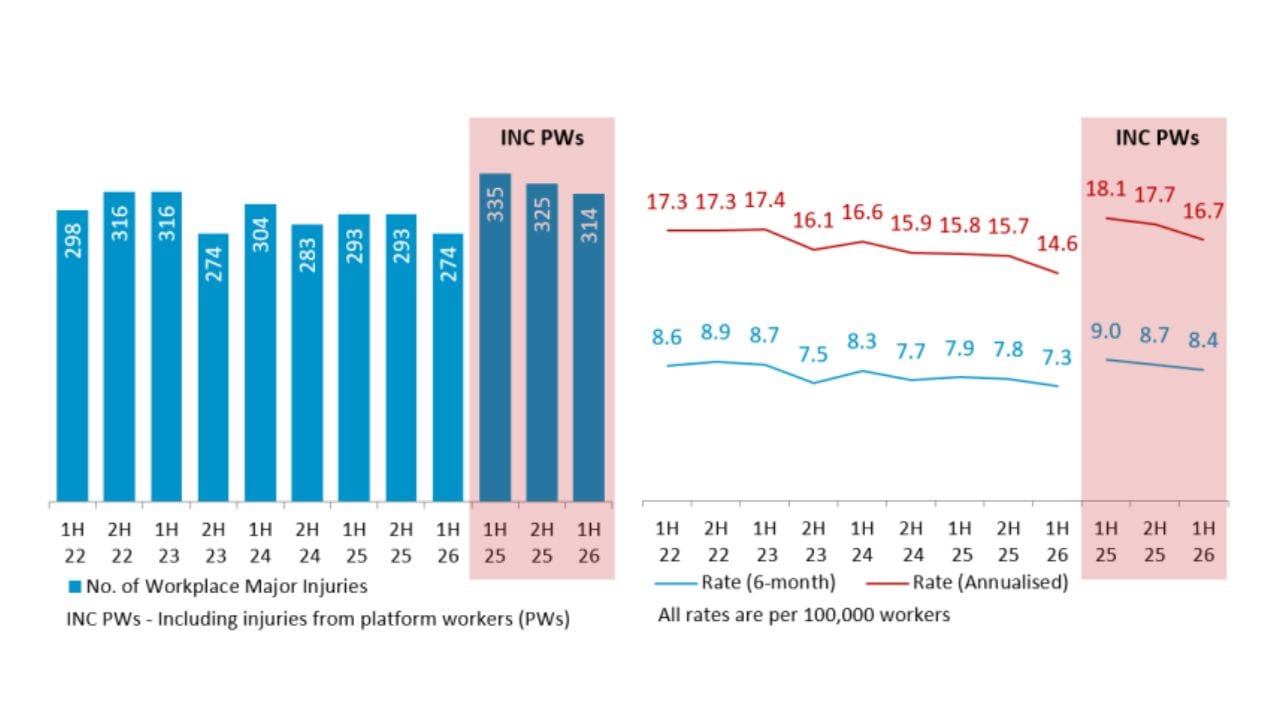
Slips, trips and falls, vehicular incidents and machinery incidents were the three leading causes of major injuries, together accounting for 190 cases, or 61% of the total. Construction recorded the highest number of major injuries at 65, followed by manufacturing at 61 and platform work at 40.
Platform workers remain a safety concern
Platform workers recorded 44 fatal and major injuries in H1 2026, unchanged from H1 2025. Their annualised fatal and major injury rate stood at 92.1 per 100,000 workers.
Vehicular incidents accounted for 38 of the 44 platform worker fatal and major injuries, while delivery services accounted for 37. The platform worker injury rate improved from 95.9 per 100,000 workers in H1 2025 to 92.1, but remained substantially higher than rates recorded across major sectors.
Occupational disease cases increase
MOM also recorded 620 occupational disease cases in H1 2026, up from 485 a year earlier. Noise-induced hearing loss was the most common condition, with 354 cases, followed by work-related musculoskeletal disorders with 142 cases.
The ministry attributed the increase partly to expanded occupational disease coverage from December 2025 and stronger reporting and surveillance.
MOM reviews workplace safety measures
MOM is reviewing further measures to strengthen workplace safety ownership and accountability.
The review will include the workplace safety demerit points system and the bizSAFE programme, with a focus on whether companies' safety performance is reflected more effectively in their capability-building and implementation.
The latest figures show a mixed picture for Singapore's workplace safety landscape: major injury rates are improving, but the rise in fatalities and persistent risks faced by platform workers remain key areas of concern.
Author
Loading...