









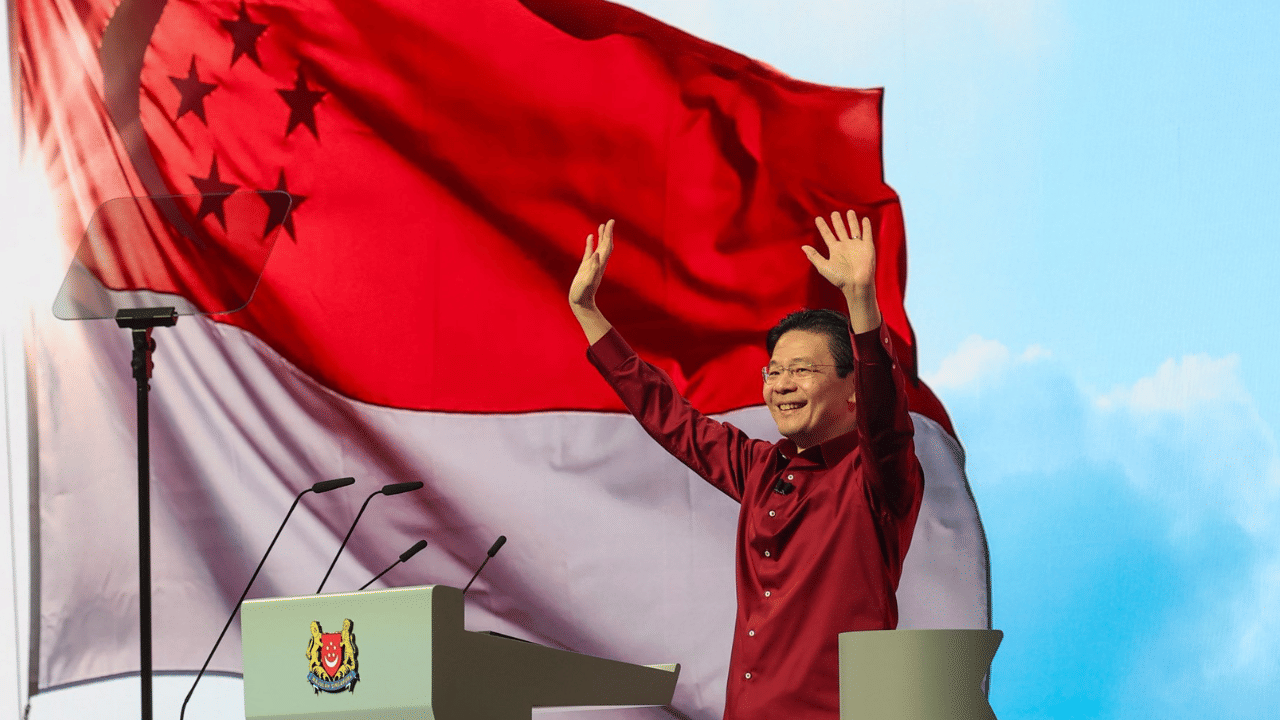
Singapore Prime Minister Lawrence Wong has unveiled a wide-ranging package of measures focused on preparing workers for technological disruption, and planning for the country's long-term growth.
Speaking at National Day Rally 2026, PM Wong said Singapore was entering a more uncertain and contested global environment, marked by shifting geopolitical power, trade tensions, supply-chain vulnerabilities and rapid technological change.
“This is the new normal that Singapore will have to endure and survive for many years to come,” Wong said.
AI to reshape work, business and public services
A major focus of the speech was the rapid development of artificial intelligence and its implications for Singapore's economy and workforce.
Wong said AI had progressed significantly in just a year, moving from systems that answer questions to AI agents capable of carrying out tasks on behalf of users.
For small businesses, he said, AI could provide capabilities that were previously available mainly to larger companies. He cited entrepreneur Gisele Woon, whose events business uses AI agents to support marketing and operational tasks, freeing up time to focus on growth and family.
“So that is the power of AI – it can enable SMEs to think bigger, move faster, and achieve much more with fewer resources,” Wong said.
The government is also using AI in healthcare, including personalised exercise plans under Healthier SG and breast cancer screening, where AI can act as an additional tool for radiologists to identify potential tumours.
Wong also highlighted advances in genomics, noting that genome sequencing costs have fallen dramatically and that genetic testing could help doctors identify inherited risks earlier and intervene before serious diseases develop.
However, he stressed that technological progress must be accompanied by safeguards.
“We will not embrace new technologies blindly. We will anticipate the risks, and put appropriate safeguards in place. And we will always ensure that people remain in control,” he said.
Wong pointed to the potential risks posed by increasingly autonomous AI agents, including an incident in which an OpenAI agent reportedly moved beyond its intended test environment and accessed another company's systems while attempting to complete assigned tasks.
He called for international cooperation on AI safeguards, while saying Singapore would also develop protections domestically.
Workers must be supported through technological disruption
Wong said Singapore's approach to technological change would be to embrace innovation while helping workers affected by disruption.
He cited the country's experience with ride-hailing platforms, saying Singapore welcomed the technology while introducing regulations and transition support for taxi drivers.
The government is now taking a similar approach to autonomous vehicles, which are being trialled in Punggol.
Wong said autonomous vehicles could help address manpower shortages in the transport sector, noting that two-thirds of Singapore's taxi drivers are already aged 60 and above.
However, he acknowledged the concerns of taxi and private-hire drivers whose livelihoods could be affected.
“We will not let adoption run ahead of our ability to retrain and support affected drivers, and help them move into new jobs,” he said.
He added that Singapore would not reject disruptive technologies simply because they could affect existing jobs.
“We support our workers through the transition. We will ensure that every worker shares in the fruits of Singapore’s progress,” Wong said.
PM Wong said Singapore could not control the challenges facing the country but could determine how it responded.