








Economy Policy
S’pore Budget 2026: PM Wong announces EP threshold to S$6,000, S Pass to S$3,600, plus expanded mid-career & senior worker support







From July 1, firms that want to hire foreign workers must pay full-time local employees at least S$1,800 a month, up from S$1,600. Part-time local workers must be paid at least S$10.50 per hour.
Singapore will raise salary thresholds for foreign work pass holders, increase levies on selected sectors and expand support for local, mid-career and senior workers, as part of a sweeping set of labour market measures unveiled in Budget 2026.
Delivering the budget statement on Feb 12, Prime Minister and Finance Minister Lawrence Wong said the changes reflect Singapore’s approach of remaining open to global talent while keeping Singaporeans at the core of the workforce.
“Foreign professionals and workers strengthen our teams, transfer knowledge and enable companies to grow – this in turn creates more and better opportunities for Singaporeans,” he said. “At the same time, we will continue to ensure that our foreign workforce complements a strong Singaporean core.”
Higher salary thresholds for EP and S Pass holders
From January 2027, the minimum qualifying salary for new Employment Pass (EP) applicants will be raised to S$6,000, up from S$5,600. In the financial services sector, where wage norms are higher, the threshold will increase to S$6,600 from S$6,200.
The qualifying salaries for older EP applicants will be raised in tandem, with renewal applications affected a year later, from 2028, to give businesses more time to adjust.
For candidates aged 45 and above, the minimum qualifying salary will rise to up to S$11,500, and to up to S$12,700 in financial services.
Similarly, the minimum qualifying salary for new S Pass applicants will be increased from January 2027 to S$3,600, up from S$3,300.
In financial services, this will rise to S$4,000 from S$3,800. For older S Pass applicants, qualifying salaries will also be raised in tandem, with renewals affected from 2028.
For candidates aged 45 and above, S Pass minimum salaries will go up to as much as S$5,100, and to S$5,650 in financial services.
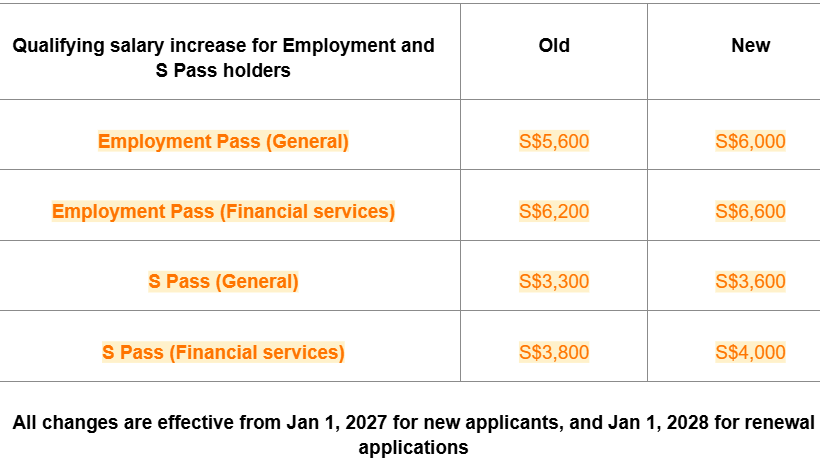
PM Wong said the move is aimed at maintaining the quality of foreign work pass holders as local wages rise.
Local qualifying salary raised, support enhanced
On the domestic front, the Local Qualifying Salary (LQS), the minimum salary firms must pay full-time local employees if they wish to hire foreign workers, will be raised from S$1,600 to S$1,800 from July 1 this year.
Part-time local workers must be paid at least S$10.50 per hour.
Each local worker earning at least S$1,800 monthly will count as one local workforce unit for quota purposes; those earning between S$900 and S$1,800 will count as half. Workers earning less than S$900 will not count towards firms’ quota entitlement.
To help businesses cope with higher wage costs, the Government will enhance the Progressive Wage Credit Scheme (PWCS). Co-funding support for 2026 will be raised to 30 per cent, up from 20 per cent, and the scheme will be extended for two more years to 2028.
From 2027, the minimum wage increase required to qualify for PWCS support will be raised to S$200, from S$100 currently.
“This will better encourage and reward the firms that invest in their workers,” PM Wong said. The measures build on the Progressive Wage Model (PWM), which links wage growth to skills upgrading and productivity.
Levies adjusted for work permit holders
Work Permit levies will also be adjusted from 2028. In the marine shipyard sector, the monthly levy for basic-skilled (R2) workers will be raised by S$100 to S$600. There will be no change to the levy for higher-skilled (R1) workers, which will remain at S$350.
In the process sector, levies for R2 workers will increase by S$150. Firms hiring R2 workers from Malaysia, North Asia and China will see levies rise to S$600 from S$450, while those hiring from non-traditional sources will see levies increase to S$800 from S$650. R1 levies will remain unchanged.
The Government will also simplify the tiered levy structure for the manufacturing and services sectors by merging Tier 1 and Tier 2 of the current Dependency Ratio Ceiling (DRC) framework.
For the merged tier, services firms will pay S$400 monthly for R1 holders and S$600 for R2 holders. In manufacturing, the rates will be S$300 for R1 and S$470 for R2 holders.
As at June 2025, Singapore had 201,200 EP holders, 177,600 S Pass holders and 1,182,500 Work Permit holders. More details will be shared during the debate on the Ministry of Manpower’s budget.
Also Read: ‘40% corporate income tax rebate’: PM Wong delivers Singapore Budget 2026
Support for mid-career and senior workers
Mid-career workers will receive additional help under enhancements to the SkillsFuture Level-Up Programme. More industry-relevant courses will be added, and the Mid-Career Training Allowance will be extended to those taking part-time courses from February.
The Government will also enhance the basic tier of the Workfare Skills Support scheme and increase the hourly allowance for workers who upgrade their skills.
For senior workers, the Senior Employment Credit, which provides wage offsets to employers who hire Singaporeans aged 60 and above, will be extended to the end of 2027.
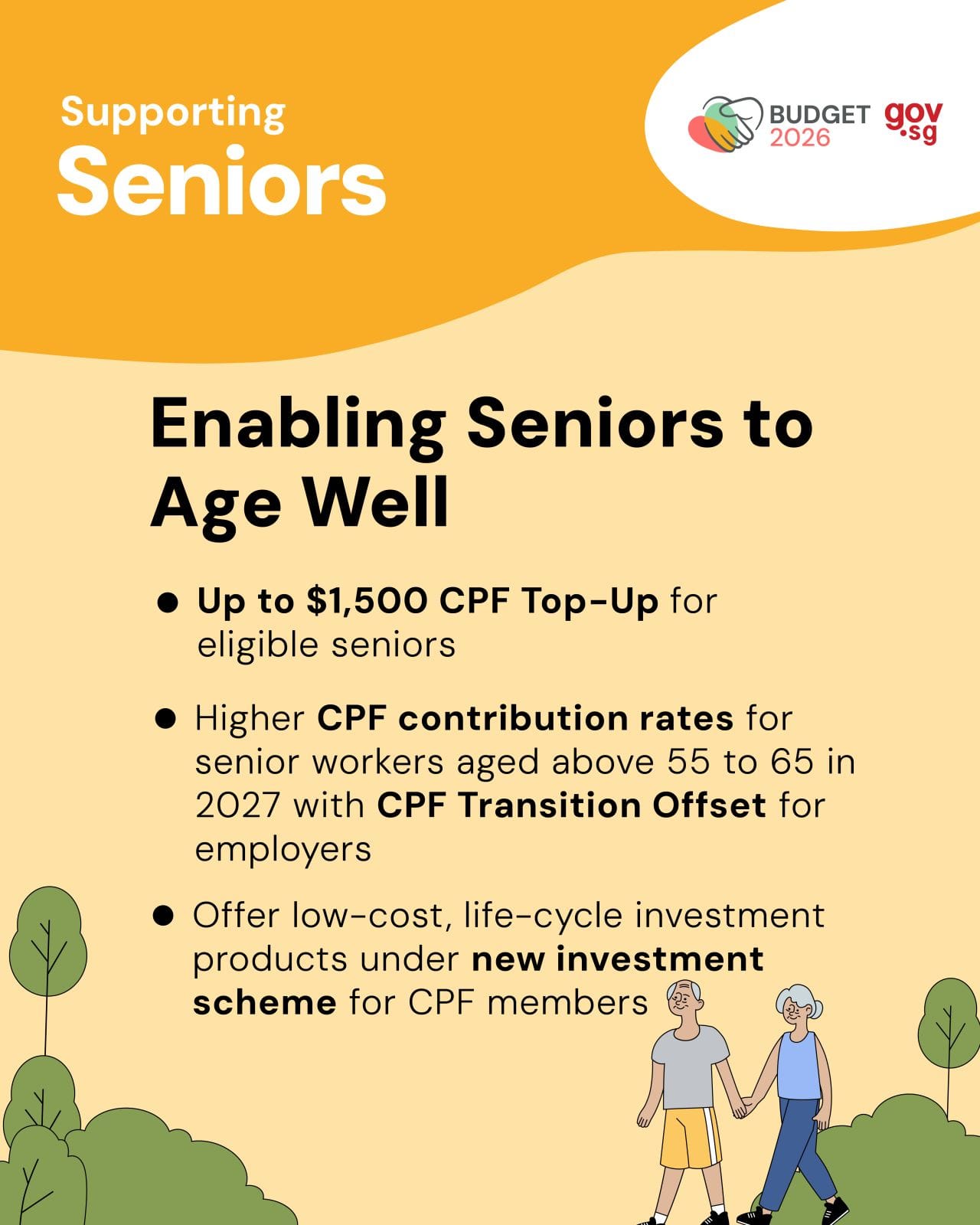
“We will support our seniors so that they can continue to contribute meaningfully,” PM Wong said, adding that employers will be supported in creating age-friendly and multi-generational workplaces.
Cost of living pressure & household support
In a further measure to cushion cost pressures, all Singaporean households will receive S$500 in CDC vouchers in January 2027. Half can be used at participating supermarkets, and the other half at heartland merchants and hawkers.
Summing up the labour market package, PM Wong said the goal is to help Singaporeans navigate economic change with confidence. “We will help Singaporeans adapt to change with confidence, move across career transitions with assurance, and build meaningful and fulfilling
careers,” he said.
“Ultimately, what matters is not just the policies we announce, but the outcomes they deliver in people’s lives.”
Beyond salary and levy changes, Singapore Budget 2026 placed a clear focus on workforce transformation as industries transform with AI. PM Wong said the Government will help Singaporeans acquire new skills, adapt to new roles, and use AI as a tool to be more productive and effective at work.
Author
Loading...